 by
by Short Summary of the Poem
We’re always told to be scared of death. Right? No one wants to die. But this poet looks death in the eye and basically says, ‘Calm down, bro, you’re overrated.’ Now let’s see how he proves it.
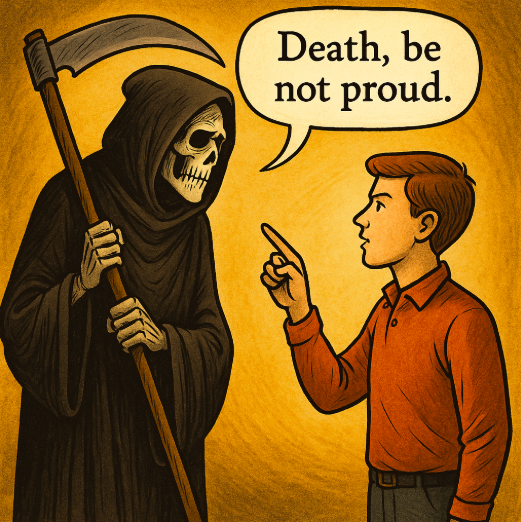
In this poem, the speaker talks directly to Death as if Death is a person. He tells Death, “Don’t be so proud,” just because people are afraid of it. According to him, Death is not actually powerful or scary. When Death comes, people don’t really end, and even when Death comes for the speaker himself, he believes he still won’t truly die.
The poet compares Death to rest and sleep and says that we all know rest and sleep are peaceful and refreshing. And that rest and sleep are like small “pictures” of Death, then imagine how peaceful real Death must be. Also, according to Donne, only the best people die in this world. It is just that their bodies rest while their souls go to the afterlife.
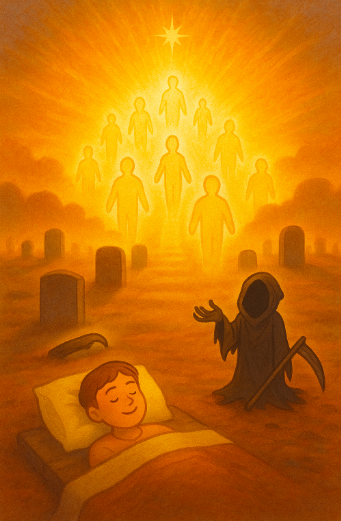
He further says that Death is not the boss of itself. It is controlled by things like fate and chance, and by people such as kings or those who act in extreme ways (for example, murderers or soldiers). Death is found wherever there is poison, war, or sickness. The speaker even says that medicines or magic charms can make people sleep and rest better than Death can!
So he asks: if Death is so limited and depends on other things, why is it so proud?
In the end, the speaker says that Death is only like a short sleep between our life on earth and our eternal life after death. Once people wake up into eternity, Death cannot touch them anymore. So, in a surprising twist, it is not people who will die forever—it is Death itself (or the fear of Death) that will be defeated and “die.”
For a detailed explanation of the poem Death Be Not Proud and other poems of class12, ISC Syllabus, go to my channel, Beauty of Language.
Main Themes of the Poem
So the theme of the poem is the Powerlessness of Death.
Donne wants to tell us that death should not feel proud or important. Why? Because human beings don’t really end when they die. After just “one short sleep” (that is, death), they live forever in eternal life.
Some people think death is very strong and powerful. But Donne says death is actually like a low-level servant. It cannot act on its own. It has to depend on things like luck, accidents, government orders, murder, disease, and war to make people “sleep” (die).
He also says that even a poppy plant (used to make a drug that makes you sleepy) or charms and spells can make people sleep—and they do this more gently and better than death does.
In the end, when a person’s soul leaves the body and goes into eternity, the soul goes on living. But death will not last forever. In a way, it is death itself that will be defeated or ‘die’, not human beings.
Poetic Devices in the Poem
- Personification– means to attribute human features to non-human things. Donne has personified death throughout the poem, telling it should not be proud. Being proud is a human quality. So, death is given a human quality of having feelings and emotions.
- Metaphor– There are three metaphors used in this poem. You know what a metaphor is. It is a literary device where comparison is done, but not clearly stated. And it is done without using the words “like” or “as.”
- The first is used in the opening line, “Death, be not proud.” Here, death is compared to a proud man.
- The second is used in the ninth line, “Thou art slave to fate.”
- Third is in the last line in an extended metaphor where death is compared to the non-existent or unrealistic object.
3. Alliteration– It is the repetition of the same consonant sounds in the same line. For example, in the line-
- And better than thy stroke; why swell’st thou then. Here “th” sound is repeated.
- Much pleasure; then from thee much more must flow. Here “m” sound is repeated.
4. Assonance– It is the repetition of the vowel sounds in the same line. For example,
- Thou art slave to fate, chance, kings, and desperate men. Here “a” sound is repeated.
- And soonest our best men with thee do go. Here “e” sound is repeated.
5. Irony– It means a statement that may mean something different from, or the opposite of, what is written. Irony often expresses something other than its literal intention, often in a humorous way. For example: “Death, thou shalt die.”
About the Poet
John Donne was a famous Metaphysical Poet. Metaphysical is basically a philosophical concept that is used in literature to describe the things that are beyond the description of physical existence. He was an English Poet, Scholar, Soldier and Secretary, who later became a cleric in the Church of England. He is considered an outstanding representative of the metaphysical poets.
About the Poem
The popularity of this poem lies in its unique subject, as it was a devotional as well as a warning to ‘personified’ death. “Holy Sonnet 10”, it is also called by its first line, “Death, be not Proud”. Donne wrote it in the early 1600s. So in this poem, he talks to Death as if Death were a person. Personification! This personification is even emphasized by the fact that the word ‘Death’ has always been mentioned with a capital ‘D’ throughout the poem.
In “Death, be not Proud,” the poet uses clear logic to show that death is not as powerful as people think. He says death doesn’t really kill anyone. Instead, when a person dies, their soul is set free and goes towards eternal life. And there is a lot more that we have to deal with in the poem.
The poem is a Sonnet, that is a poem of 14 lines. It is one of Donne’s “Holy Sonnets,” a group of religious poems where he thinks about big questions of life, death, and God through his faith.
Line by line Analysis
Lines 1-2
Death, be not proud, though some have called thee
Mighty and dreadful, for thou are not so;
Explanation
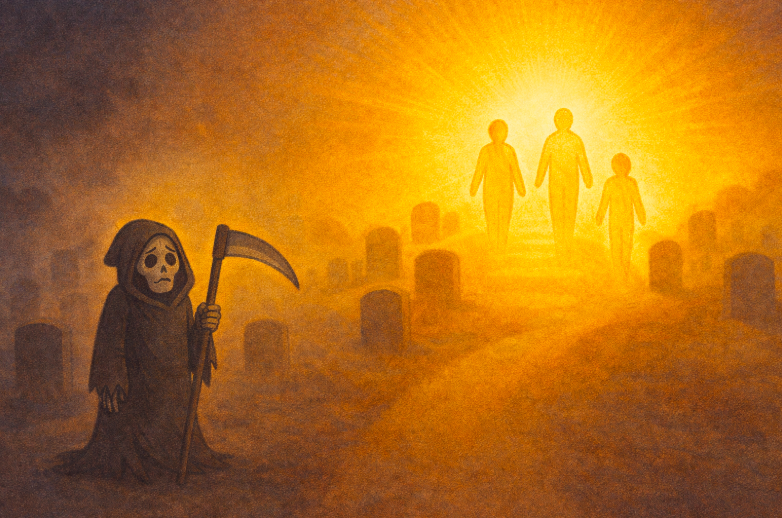
People usually think that Death has great power and can do terrible things. Because the first thing that comes to our mind when we hear about Death is Fear. So, in this poem, we talk about Death as “he” because Donne treats Death like a person. You must have seen the picture of a hooded figure with a sickle in his hand. Imagine that, as death, when being referred to as a person.
Now when I said Death being referred to as a person. The first figure of speech that instantly strikes your mind is?? Personification. But here, one more figure of speech is used. And that is, Apostrophe. Now, what is Apostrophe? See, when a poet speaks directly to someone or something that is not really there and cannot answer, it is called an apostrophe. And THIS poem is one of the classic examples of apostrophe in literature.
So the speaker, that is, the poet, is not scared of Death at all. He talks to Death boldly, like someone standing up to a school bully. He tells Death, “Don’t be proud,” and says that people are wrong to think of Death as something very frightening and powerful.
You can be asked in the exam that,- “Death, be not proud, for thou art not so, / When some of thy best, the most of thee, do go.” — Explain how the poet uses these lines to challenge Death’s supposed might.
Lines 3-4
For those whom thou think’st thou dost overthrow
Die not, poor Death, nor yet canst thou kill me.
Explanation
In these two lines the poet says that Death thinks he has the power to kill people, but according to him, he actually doesn’t. Now here Donne has used the word “overthrow” instead of “kill.” And when do we use the word Overthrow? We usually use “overthrow” when a king or ruler is removed from power. So this makes Death look like someone trying to act like a big ruler.
You will notice here that there is also a small pause between the words “overthrow” and “die” in the line. It feels like the poet lets Death enjoy the thought that he can kill people, and then suddenly says, “Actually, you know what? you can’t,” and takes that power away.
Then, in the fourth line, the poet calls him “poor Death”. It is as if Death’s big dreams have been crushed, and now we feel a little sorry for him. Ki haaye bechara, which is almost insulting to death. He humiliates him for having lived under the illusion, the misunderstanding, the little bubble, that he has power over life.
But see, the thing is that saying that Death doesn’t kill people sounds strange, right? That’s what Death is supposed to do! So how can Donne say this?
So he actually uses Christian belief to explain it. According to this belief, when a good Christian dies, their life on earth ends, but their soul goes to eternal life. So death is not the final end; it is just a gateway to a never-ending life. In that sense, people are never truly “killed” forever. Therefore, Death is not as powerful as it thinks. He kind of taunts him, saying that though you can take my physical body, you can never truly kill me.
Lines 5-6
From rest and sleep, which but thy pictures be,
Much pleasure; then from thee much more must flow,
Explanation
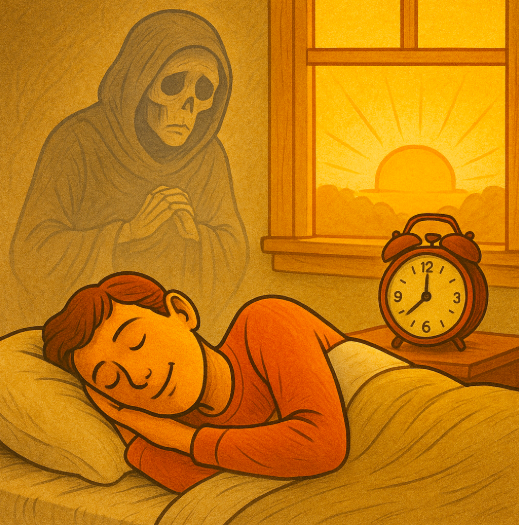
These two lines are a bit tricky, so we need to read them slowly and think carefully. See the poet Compares Death to Rest and Sleep. Rest and sleep usually make us feel good and relaxed. So, he says, in the same way, death should also give us pleasure when it comes.
He also says that rest and sleep are like “Pictures” of death.
Think of it like this: a drawing or photo of something is not the real thing; it’s just a copy. Rest and Sleep are the pictures, and Death is the real thing. So basically, rest and sleep are just small, weaker versions of death. Jab ye weaker version hume itni acchi lagti hain, toh jo real cheez hai, yaani ki death, woh aur kitna hi pleasure degi! If even these small versions feel good, then the real thing (death) will give us “much more” pleasure, as if that pleasure is flowing like water or honey.
The comparison that is made between rest and sleep and Death is an example of which figure of speech? It is a Metaphor!
This comparison of death to sleep or rest is very common in Christian writing. Many Christian thinkers (like Saint Augustine) say that real rest will happen only when a person rests with God in Heaven.
This is a way to reduce the fear of death: if you compare death to something people already enjoy—like a good sleep—it feels less scary.
In the context of sleep, you can be asked question like- Discuss the significance of the comparison between Death and sleep in the poem, highlighting how it contributes to the overall message.
Lines 7-8
And soonest our best men with thee do go,
Rest of their bones, and soul’s delivery.
Explanation
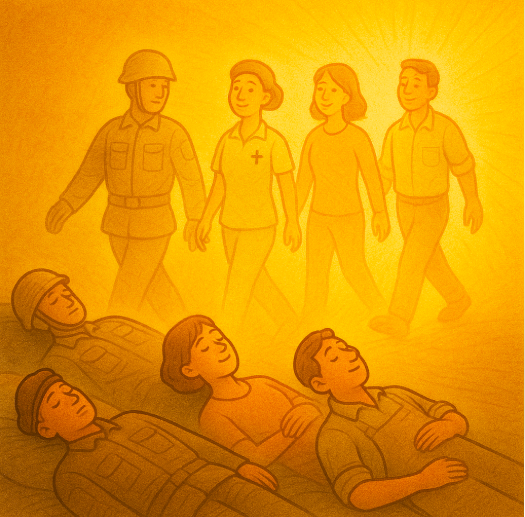
In the 7th line, he says that the “Best Men” are the good, brave people in the society. Donne says that these people are the ones who meet Death earlier than others. They go to Death willingly because they believe he will give rest to their bodies and set their Christian souls free from the sufferings of this world.
If you will notice, then in the 8th line Donne uses the word “Delivery” to describe this. “Delivery” here can also mean to give birth, which completely fits the whole idea of starting a new life in eternity after death.
Now these “best men” which are being talked about here can be the Soldiers and Martyrs, who are ready to risk their lives for a noble cause or for their faith. Donne almost makes it sound as if they are happy to go to death, because they know they will get eternal rest sooner than others.
But if we think carefully, this is a bit tricky. In real life, most soldiers are not excited to die; they are willing to face danger, not wish for death itself. They accept the risk of death to protect others or to achieve something important.
So the poem presents death in such a positive way that it almost tempts you to think, “Being one of the brave ‘best men’ and facing death doesn’t sound so bad after all.”
Lines 9-10
Thou’art slave to fate, chance, kings, and desperate men,
And dost with poison, war, and sickness dwell,
Explanation
In a Petrarchan sonnet like this one, there is a complete change in the direction of the poem, the mood of the poem. That is at line 9.
So in this poem, “Death, be not Proud,” the change is not very big, but from line 9 the tone of the speaker becomes sharper and more angry. He starts insulting Death, calling him a “Slave.”
By calling Death a slave, the poet is saying that Death has no freedom of his own. He does not decide anything himself. Instead, he is controlled by other things. Now, what are those things that he is controlled by? It is Fate, Chance, Kings and Desperate Men.
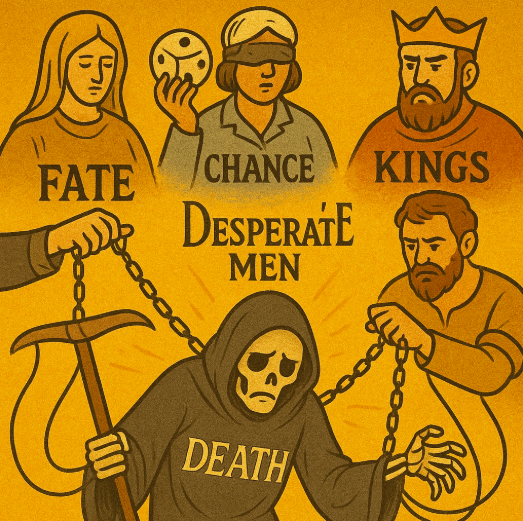
- Now talking about Fate then it often shown in literature as a person who controls what happens in everyone’s life, including when they will die. Woh kehet hain na, jo kismat me likha hoga wahi hoga. So just like that. And Death only follows the orders of Fate.
- Then, Chance – It is the opposite idea of fate; it means pure luck, when things happen for no clear reason (like a sudden accident). I don’t know if you have heard this story that there was a man, who was so afraid of death, that he tried every possible thing to save himself from it, but at the end died from the wall clock falling over his head, in his bedroom itself, on his bed!! So that is chance, that is luck.
- Then there are Kings – real rulers who can send soldiers to war or order someone to be killed.
- And the Desperate Men – people who take their own lives or behave so recklessly that they almost choose death themselves. If you decide to take your own life, it kind of robs Death of the only card he has to play.
So Death is not the boss; he is just used by all these forces.
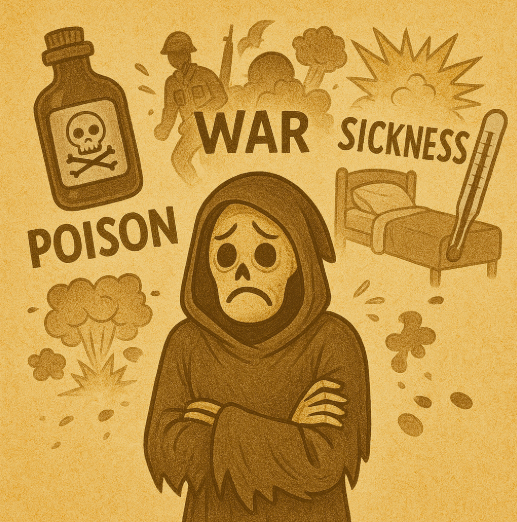
Then, in line 10, the speaker accuses Death of “Dwelling”, that is, living with Poison, War, and Sickness. It is as if these are friends or companions of Death. All three have one thing in common. And what is that? They kill many people, and they usually cause painful and miserable deaths.
Donne also treats poison, war, and sickness like people. Again, this is personification, to show that Death moves in bad company and is not noble or powerful at all. Badi galat sangati me rehta hai Death.
In this context, you can be asked question like- How does the poet portray Death as “slave to fate, chance, kings, and desperate men,” and what does this reveal about its true power?.
Lines 11-12
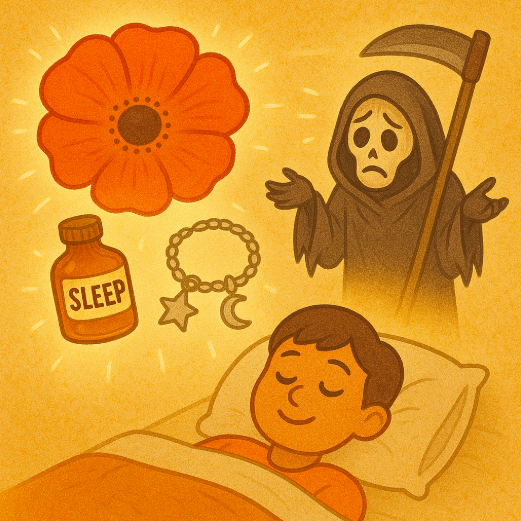
And poppy’or charms can make us sleep as well
And better than thy stroke; why swell’st thou then?
Explanation
So if we look back to lines 5 and 6, the poet says that death is like sleep, only better.
But now he changes his tone and says, “Why do we even need Death?”
If someone wants deep sleep and rest, they can simply use Drugs or Magic Charms. This actually doesn’t fully match his earlier point that death is better than sleep, but the speaker is not worried about perfect logic here. His main aim is to insult Death and show off his cleverness, like someone arguing quickly and sharply in a debate.
Now the “Poppy” which is being talked about here is, as you know, and must have heard that it is a flower used to make opium, an old drug that makes people feel very relaxed and sleepy. The speaker says that drugs and magic charms work even better than Death at making people sleep. We’re like: and you know this how?
You can notice here that the poet has used the word “stroke” in line 12. It can have many meanings:
- It can mean Gently Stroking someone, like a parent stroking a child’s head to help them sleep.
- It can mean the Stroke of a Sword, which suggests violence and killing.
- It can also mean the Stroke of a Clock, the exact moment when something happens—like the moment of death.
By saying all this, the speaker completely cuts down Death’s importance. He tells Death not to “Swell” with pride. This question he asks Death at the end of the passage sums up the whole argument so far: Death is not powerful, not special, and not worth being proud.
In this context you can be asked question like- What is the significance of the phrase “pictures of our slumber” (poppy, charms) in relation to death?
Lines 13-14
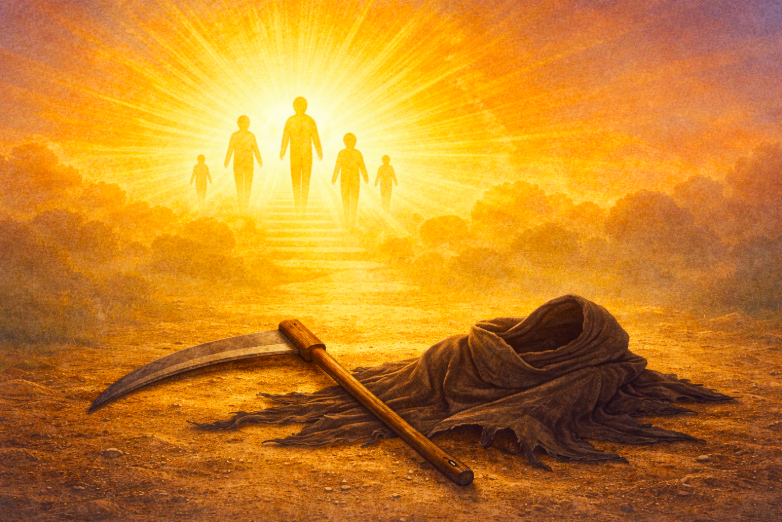
One short sleep past, we wake eternally,
And death shall be no more; Death, thou shalt die.
Explanation
Now finally we reach the end of the poem. So John Donne, and the Metaphysical Poets in general, are masters of the surprise ending. The poem ends with a surprising twist.
At the end, he goes back to the idea that death is like sleep, but now he adds an important detail: it is only a “Short Sleep.”
According to traditional Christian belief, when people die, it is as if they are sleeping until Judgment Day, the end of the world. And on that day, Jesus will “wake” everyone up, and good Christians will go to Heaven forever. After that, there is no more death at all.
So, when the world ends and eternal life begins, death itself will disappear. That’s why the poem ends with the powerful line: “Death, thou shalt die.” It means that in the end, death YOU will be destroyed, not human souls.
Here you can be asked like-
“And death shall be no more; Death, thou shalt die.” — Explain the meaning and significance of this concluding paradox.