

 by
by Motilal Babu, a landlord from Kathaliya, was travelling back home by boat with his family. One afternoon, the boat stopped near a market so that food could be prepared. At that time, a young Brahmin boy named Tarapada, about fifteen or sixteen years old, came up to them. He politely asked Motilal Babu for a lift to Nandigram, and Motilal Babu agreed.
Watch the explanation in Hindi-
Tarapada was a handsome boy with a fair complexion and graceful manners. He surprised everyone by helping the servant clean and cook fish and vegetables. After bathing and changing his clothes, he joined Motilal Babu, his wife Annapurna, and their nine-year-old daughter Charushashi for lunch. Annapurna was very impressed by Tarapada and became curious about his family.

When Annapurna questioned him, Tarapada explained that although his family loved him deeply, he had run away from home at the age of seven or eight. He had no strong reason for leaving, except that he had a restless nature and could not stay in one place. Since then, he had travelled with different groups, such as a jatra troupe, panchali singers, and later a gymnastics group. Whenever people grew fond of him, he would quietly leave. He had also learned to play the flute very well. Recently, he had left a gymnastics troupe and was heading towards Nandigram, where he had heard a new jatra group was being formed. Even after meeting many kinds of people, Tarapada remained innocent and untouched by worldly influences, which immediately attracted Motilal Babu.
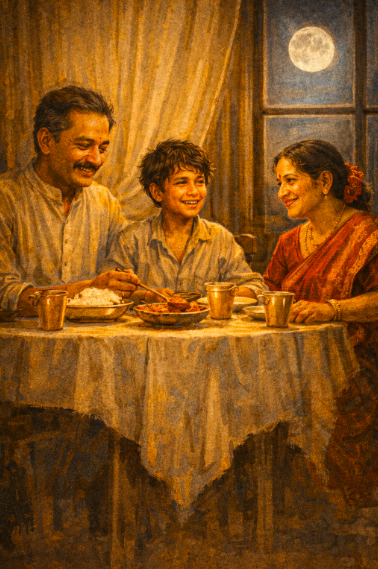
As the boat continued its journey, Annapurna tried to ask Tarapada more about his home, but he gave short replies and moved to the deck. There, Tarapada felt peaceful watching nature pass by. He easily became friendly with the helmsman and oarsmen and even helped them steer and row the boat. Annapurna was concerned when Tarapada said that he did not eat regularly and refused milk, though he liked sweets. This showed his careless attitude towards comfort.
For the next three days, Tarapada helped with shopping, cooking, and sailing. He was curious, quick to learn, and fully involved in whatever he did. He knew many songs and stories. One evening, while Motilal Babu was reading the Ramayana, Tarapada suddenly sang a beautiful panchali about Kush and Lav, playing the flute. His performance impressed everyone, including the boatmen and people along the riverbank. Annapurna was deeply moved and felt like hugging him, while Motilal Babu began thinking of keeping Tarapada as a son, since he had none. Only Charushashi felt jealous.
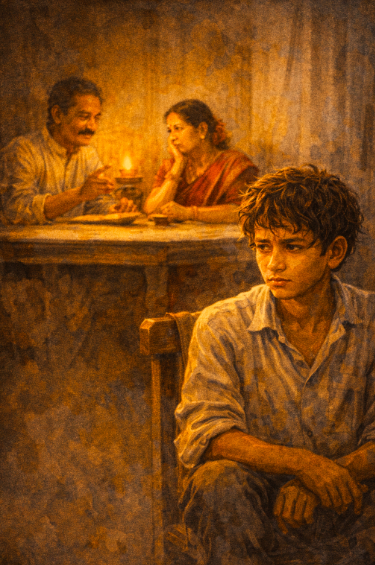
Charushashi was her parents’ only child and was used to getting all their attention. She was stubborn and short-tempered, often throwing tantrums over small things like clothes or hair. At times, she could be extremely affectionate towards her mother. Now, her strong emotions turned into anger towards Tarapada. She complained about food, scolded servants, and refused to accept Tarapada’s talents. When Tarapada sang about Kush and Lav, Annapurna hoped it would soften Charu, but Charu reacted with dislike. Realising her daughter’s jealousy, Annapurna stopped showing affection to Tarapada in front of her. Later, she secretly listened to him sing after Charu had gone to bed, which made Charu furious.
Despite Charu’s hostility, Tarapada was curious about her fiery nature. He tried to please her by telling stories, singing, and playing the flute, but she never softened. Only when Tarapada swam in the river did Charu secretly watch him with interest, though she pretended not to care.
The boat passed Nandigram, but Tarapada did not even notice it. The journey continued for nearly ten days through different rivers until they reached Kathaliya. Motilal Babu received a grand welcome from the villagers. Tarapada quietly slipped away and soon made friends with everyone. He addressed people warmly and helped with all kinds of work—making sweets, weaving, and even working at the potter’s wheel. He became very popular in the village.
Charushashi’s dislike for him, however, only grew stronger. Her jealousy became extreme when she found out that her friend Sonamani, a young widow, already knew Tarapada. In anger and shame, Charu broke Tarapada’s flute. Tarapada was not angry; instead, he was amused and even more intrigued by her behaviour.
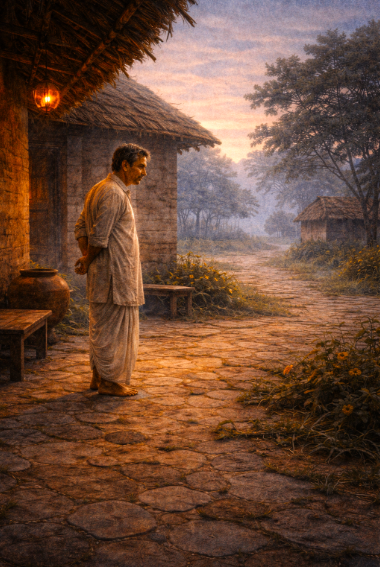
Later, Tarapada became interested in the English picture books in Motilal Babu’s library. When Motilal offered to teach him English, Tarapada eagerly agreed and learned quickly. He stopped spending time with village friends, which saddened them. He also began eating outside the women’s quarters, upsetting Annapurna, though Motilal supported his studies.
Charushashi demanded to learn English too, mainly to disturb Tarapada. She made no progress and often ruined his work by spilling ink, tearing pages, or stealing pens. Tarapada mostly laughed at her behaviour, sometimes lightly slapping her when she crossed limits. One day, when she damaged his work badly and he remained silent instead of scolding her, Charu became frightened. Unable to apologise directly, she wrote a promise saying she would not spoil his books again. Tarapada laughed, which embarrassed her deeply.
Nearly two years passed—an unusually long stay for Tarapada. Charu, now eleven, was being considered for marriage. Noticing Charu’s interest in Tarapada, Annapurna suggested him as a suitable match. After inquiry, Motilal Babu found Tarapada’s family to be poor but respectable Brahmins. A marriage proposal was sent and accepted, though Charu was not informed.

One moonlit night, Tarapada saw boats heading to a festival, filled with music and excitement. The monsoon sky, thunder, lightning, and the sound of celebration awakened his old desire to wander. The next morning, as wedding preparations arrived and Tarapada’s family reached the village, Tarapada was nowhere to be found.
Before he could be tied down by marriage and emotional bonds, Tarapada disappeared into the stormy monsoon night, returning once again to his free, wandering life.

Question Suggestions
A. Very Short Answer Questions (1–2 marks)
- Who is Tarapada?
- Why is the story titled Atithi?
- Where does Tarapada first meet Motilal Babu?
- What special talent does Tarapada possess?
- Why does Tarapada not stay in one place for long?
- Who wants Tarapada to settle down?
- What proposal is made for Tarapada?
- How does Tarapada react to the idea of marriage?
- When does Tarapada leave Motilal Babu’s house?
- What does Tarapada take with him when he leaves?
B. Short Answer Questions (5 marks)
- Describe Tarapada’s nature in the story.
- Why does Motilal Babu become attached to Tarapada?
- How does music reflect Tarapada’s personality?
- Why is Tarapada called a “free spirit”?
- What role does hospitality play in the story?
- Why does Tarapada feel uncomfortable in Motilal Babu’s house despite the love he receives?
- How does the marriage proposal create conflict in the story?
- Explain Tarapada’s silent departure. Why does he not inform anyone?
C. Long Answer Questions (10 marks)
- Discuss Tarapada as a symbol of freedom and restlessness.
- How does Tagore contrast freedom and responsibility in Atithi?
- Analyse Motilal Babu’s character. Is he selfish or caring? Give reasons.
- “Comfort can sometimes become a cage.” Explain this statement with reference to the story.
- Explain the significance of Tarapada’s final departure. What message does it convey?
- How does the story show the conflict between individual choice and social expectations?
- Justify the title Atithi.
- What message does Rabindranath Tagore convey through Atithi?
- How does the story teach respect for personal freedom?
- State the central idea of the story.
- What is the core conflict in Atithi?
D. Character-Based Questions
Tarapada
- Sketch the character of Tarapada.
- Is Tarapada irresponsible or honest to his nature? Justify your answer.
- How does Tarapada’s behaviour challenge societal norms?
Motilal Babu
- How does Motilal Babu represent traditional society?
- Why is Motilal Babu unable to understand Tarapada completely?
E. Theme-Based Questions
- Explain the theme of freedom vs attachment in the story.
- How does Atithi highlight the idea of individual identity?
- Discuss the theme of transience (temporary nature of relationships).
- How does Tagore portray the idea that love cannot be forced?
G. Value-Based Questions
- Do you think Tarapada was right in leaving without informing Motilal Babu?
- Is freedom more important than emotional bonds? Discuss with reference to the story.
- What lesson does the story teach young people about life choices?
- How relevant is Tarapada’s character in today’s world?