 by
by This is a story written in the first person. That is the writer is telling about the experience he had with the photographer. Stephen (the writer) is 40 years old when this incident happens. He wants to get his photograph taken so he can give it to his friends. He wants them to remember him after he dies. So he goes to a photographer’s studio.
For a quick summary of the story, visit my channel Beauty Of Language.
Then he describes the photographer. He is a dull-looking man who walks with a bent back. He tells Stephen to wait, and Stephen ends up waiting for about one hour. During this time, Stephen reads some magazines.
Then the photographer finally calls Stephen in and asks him to sit on a stool. The photographer brings out a big camera and goes under the black cloth. He does not seem happy with what he sees, so he comes out and removes the curtains with a rod, probably to let in more light.
Then he goes back under the cloth for a long time. Stephen jokes in his mind that the photographer might be praying to God to take a good photo.
After some time, the photographer comes out looking very serious and says Stephen’s face is “wrong.” He says it would look better if it were fatter and more chubby. Stephen feels hurt, but he agrees politely. He also jokes back that even the photographer’s face would look better if it were more chubby.
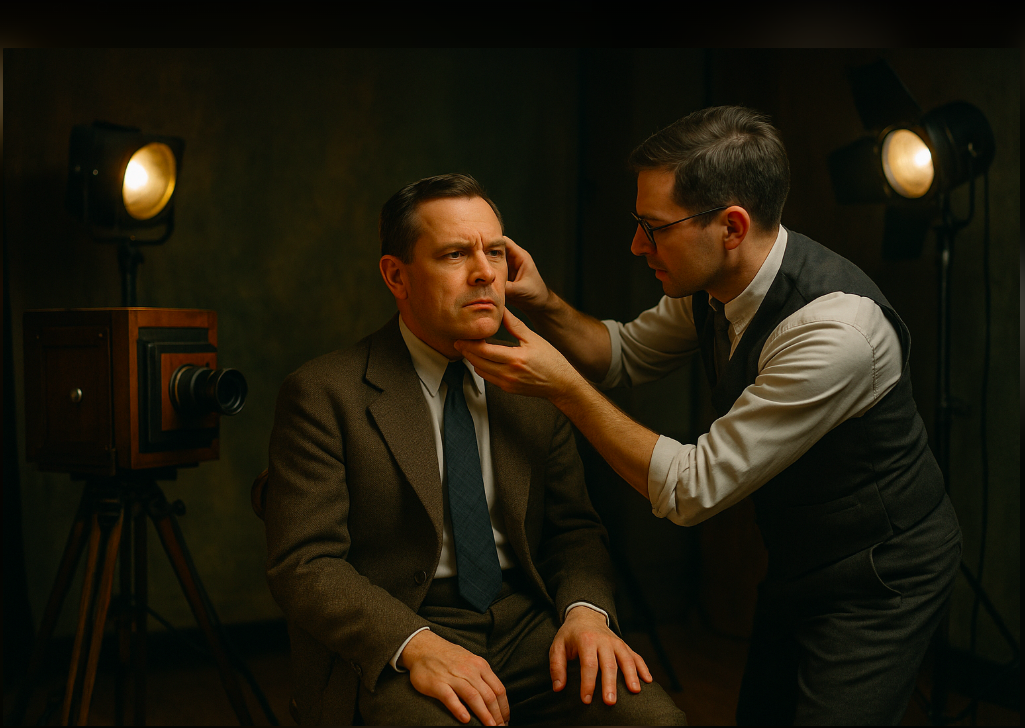
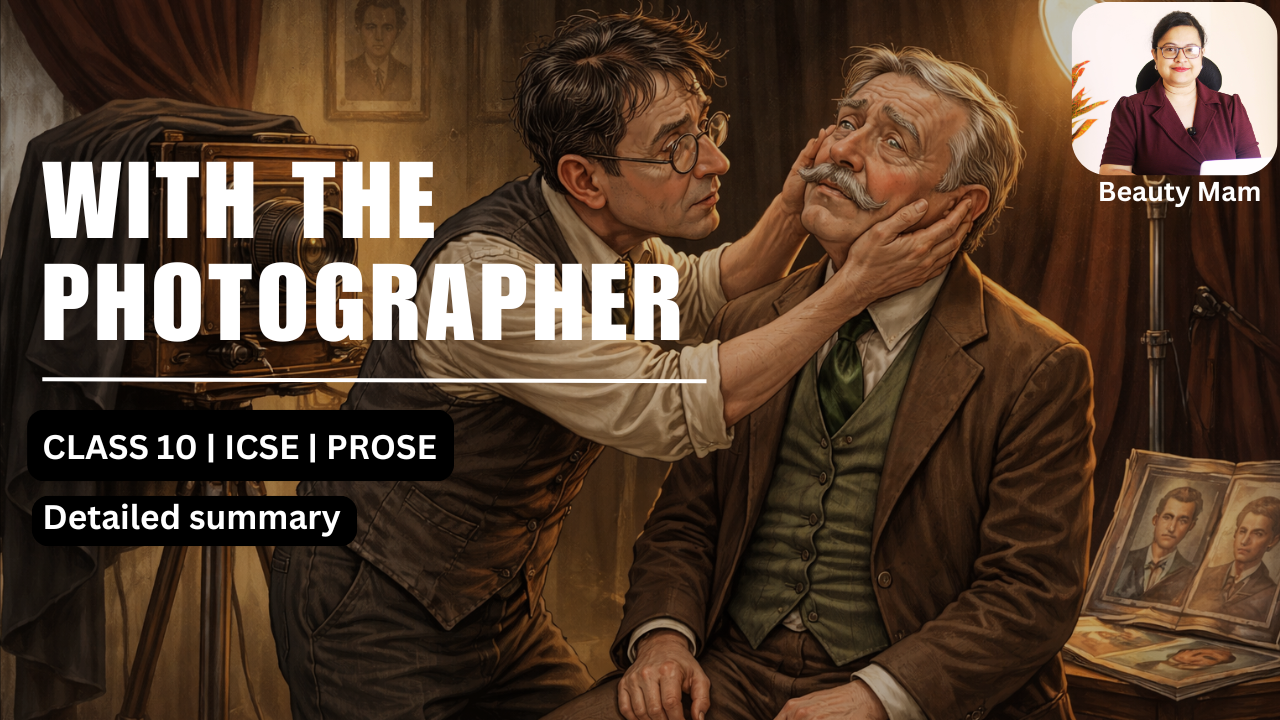
The photographer then starts behaving very strangely. He holds Stephen’s face in his hands and twists it from side to side. He thought that the photographer is going to kiss him, so he closed his eyes. But obviously he wasn’t going to. Then the photographer says Stephen’s head is not good. He goes back to the camera and keeps giving Stephen instructions: open your mouth, close it, change your expression. He even complains about Stephen’s ears. He makes Stephen droop his ears, roll his eyes. He says-put your hand on your knees, bend your neck, and squeeze your stomach, so that his face looks fuller. Even after all these, the photographer is not satisfied.
Stephen finally gets angry and tells him to STOP! Because no one likes to be told that they are not good-looking, or their eyes are not good, ears are not good. He felt bad. He said that this face is my face, and I have lived with it for 40 years! This is the face God has given him. He knows it may not be handsome, but it is his real face. It is HIS face, HIS eyes, HIS ears, and he has learned to live with it and love it.
Just when Stephen is about to get up, the photographer suddenly clicks the photo. He says he has somehow managed to capture the “right expression.”
Stephen asks to see the photo, but the photographer says he must come back on Saturday because the negative has to be developed first.
On Saturday, the photographer shows Stephen a proof (sample photo). But it does not look like Stephen at all. When he saw his photo, the first thing he said- Is it me? The photographer proudly says, yes it is you.
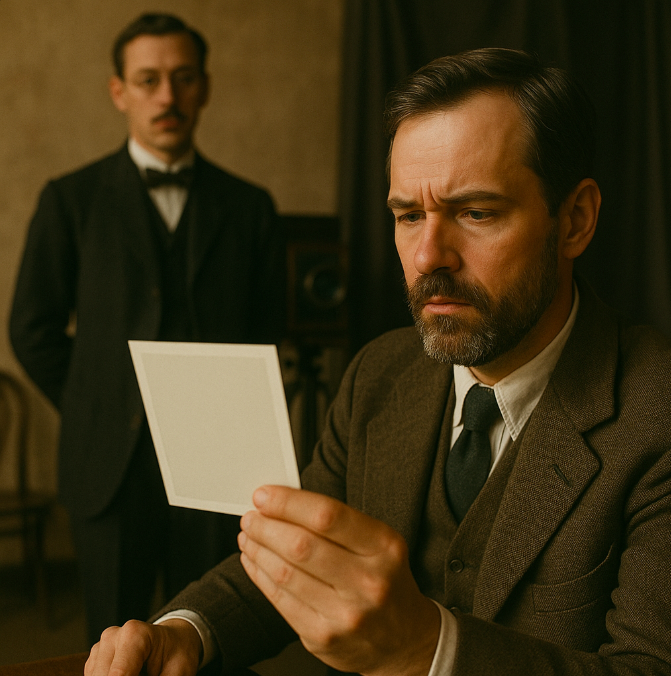
He said the eyes don’t look like mine. He said I have retouched them. Isn’t that splendid?
Then he said that my eyebrows are definitely not like that. The photographers said- No. And then he gives a technical explanation for that they have a process now, called the Delphide. And with the help of this process, he has added new eyebrows. He even further explains that he has applied it to carry the hair away from the brow. Because HE doesn’t like the hair low on the skull. Then the writer sarcastically asks that- Oh you don’t like it. Don’t you? Then the photographer further, without hesitating, says- No. He says that how he likes eyebrow hair.
Then he asks about his mouth. He asks. Is that mine? Then the photographer answered, umm I have adjusted it a little. Yours is too low. I couldn’t use it.
Then he says that his ears look like mine. And then asks again, is it me? The photographer says yes. And then he goes on saying, that I can fix that in the print. And again tells him about a process called The Sulphide, which will help to remove his ears completely. While the photographer was explaining these. Stephen cut him in between and said- Listen!! I came here for a photograph, that would have looked like me. I only wanted a photo that showed my face exactly as God gave it to me, even if it wasn’t a very special gift. I wanted my friends to keep it after my death, so they could accept my loss and remember me. But I was wrong. People don’t make such honest photographs anymore.
So go ahead and do your work. Take your negative, whatever you call it, and treat it with any chemicals you like, dip it in sulphide, bromide, oxide, or cowhide. Change everything: remove the eyes, fix the mouth, reshape the face, improve the lips, even make the tie look new, and rebuild the waistcoat. Add a thick shine, darken it, raise the details, cover it in gold, keep polishing it until even you agree it is “perfect.”
And after all that, keep it for yourself and your friends. They may like it. But for me, it is nothing more than a worthless little decorative thing.
And then Stephen leaves the studio with tears in his eyes.
The story shows how the narrator’s confidence breaks when the photographer keeps criticising his face and features. It highlights the gap between how a person really looks and how a photo can be artificially “improved.” In the end, the narrator wants an honest photograph that shows his real self, not a fake, perfect version. The writer also makes fun of the photographer’s rude behaviour and connects it to today’s pressure of edited photos and unrealistic beauty standards.

Question Suggestions
Very Short / Objective (1 mark)
- Why did the narrator go to the photographer?
- How long was the narrator made to wait?
- Where was the narrator asked to sit?
- What did the photographer do to the curtains, and why?
- What did the photographer say was “wrong” with the narrator’s face?
- On which day was the narrator asked to return for the proof?
- What is a “negative” (in photography)?
- What was the narrator’s reaction after seeing the proof?
- What kind of story is this—serious, tragic, or humorous? Give one reason.
- What does the narrator call the final photo at the end?
Short Answer (2 marks)
- Explain why the narrator wanted a photograph in the first place.
- Describe the photographer’s behaviour during the photo session.
- Why does the narrator think the photographer might be “praying” inside the camera?
- How does the photographer try to “improve” the narrator’s appearance?
- Why does the narrator feel insulted when the photographer comments on his face?
- What is the difference between what the narrator wants and what the photographer delivers?
- How does the narrator show polite humour at first, and how does his tone change later?
- Why does the proof not resemble the narrator?
- What does the narrator mean when he says people don’t do “honest” photographs anymore?
- State any two things that create humour in the story.
Long Answer (5–6 / 8–10 marks)
- “The story is a criticism of artificial standards of beauty.” Discuss with examples.
- How does Stephen Leacock use humour and exaggeration to convey the narrator’s frustration?
- Describe the narrator’s emotional journey from the start to the end of the story.
- Sketch the character of the photographer. What kind of person is he?
- “The photographer behaves more like a sculptor than a photographer.” Explain.
- Do you think the narrator’s reaction at the end is justified? Give reasons.
- What message does the story give about identity and accepting oneself?
- Write the incident in your own words, highlighting the main events and the ending.
Character & Theme-Based Questions
- What kind of man is the narrator? Support your answer with incidents.
- How does the story show the narrator’s self-respect?
- What does the story suggest about society’s obsession with looking “perfect”?
- How does the photographer represent “modern” artificial thinking?
- Bring out the theme of appearance vs reality in the story.
Humour, Irony, and Style Questions
- Identify two examples of irony in the story.
- How does exaggeration make the situation funny?
- Why is the narrator’s description of the photographer comical?
- Explain the humour in the narrator’s long speech about chemicals and “fixing” the photo.
- What is funny about the way the photographer gives commands (mouth, ears, eyes, neck, stomach)?
“Explain the Line / Phrase” Questions
- Explain: “My face is wrong.”
- Explain: “I wanted something that would depict my face as Heaven gave it to me.”
- Explain: “It is but a worthless bauble.”
- Explain: “He was a dull, stooping man.”
- Explain: “I was mistaken. What I wanted is no longer done.”