
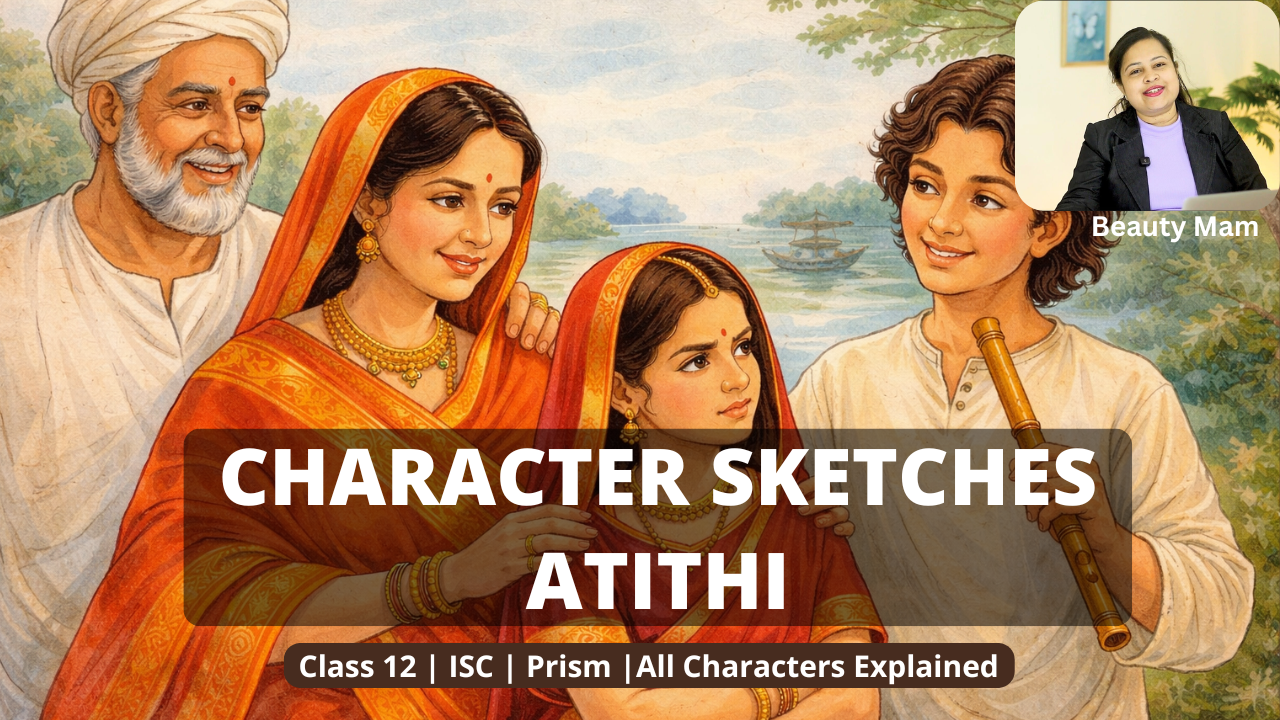
 by
by Character Sketch of Tarapada
Tarapada– The Boy Who Chose Freedom Over Comfort
1. First Impression – Attractive and Innocent
Tarapada is introduced as a handsome boy of about fifteen or sixteen years. He has fair skin, large graceful eyes, and a charming smile. When he first meets Motilal Babu and asks for a ride on the boat, he immediately creates a good impression.
His outer beauty reflects his inner innocence. He is pure-hearted and not influenced by negativity. That is why people trust and like him quickly.
2. A True Wanderer
The most important quality of Tarapada is his love for freedom.
Even though his family loved him deeply, he ran away from home at the age of seven or eight. He was not unhappy. He simply could not stay in one place. He had a natural desire to travel and explore.
He joined different groups, like:
- theatre troupes
- panchali singers
- gymnasts
But he never stayed long. Whenever people became attached to him, he left quietly. He values movement and new experiences more than stability and security.
3. Skilled and Adaptable
Tarapada is not careless or irresponsible. In fact, he is very capable.
On Motilal Babu’s boat:
- He helps in cooking.
- He rows and steers the boat.
- He quickly learns new tasks.
He is also talented in music. He plays the flute beautifully and sings the story of Kush and Lav in such a touching way that everyone is impressed.
His travelling life has made him practical, intelligent, and adaptable.
4. Detached from Family Bonds
When Annapurna asks about his mother, Tarapada answers calmly that she has other children. This shows that he does not feel deeply tied to family responsibilities.
This does not mean he is cruel. It means he does not want to be emotionally bound. He prefers independence over attachment.
5. His Role in Motilal Babu’s Family
Motilal Babu and Annapurna become very fond of Tarapada. They even think of keeping him as a son and later plan his marriage with their daughter Charushashi.
Charushashi becomes jealous and even breaks his flute. But Tarapada does not react angrily. He remains calm and detached.
When marriage plans begin, Tarapada even starts studying English, as if he might settle down. But when the wedding day arrives, he disappears.
He chooses freedom over marriage and security.
6. Symbolic Meaning
Tarapada is more than just a character. He represents the human desire for freedom.
He is like:
- a flowing river that cannot be stopped
- a bird that cannot be kept in a cage
Through Tarapada, Tagore shows the conflict between freedom and attachment. Society wants people to settle down, marry, and follow rules. But Tarapada represents those rare individuals who cannot be confined.
Conclusion
Tarapada is kind, talented, adaptable, and charming. But above all, he is a free spirit.
He cannot be tied down by love, comfort, or marriage. That is why he remains an Atithi — a guest — who comes into people’s lives, wins their hearts, and leaves before he can be permanently bound.
Character Sketch of Charushashi
Charushashi- A Child Torn Between Attention, Control, and Growing Up
1. A Child With Strong Emotions
Charushashi is shown as a child who feels everything very strongly.
Her anger, jealousy, love, and tantrums are not “extra drama.” They reflect how children sometimes behave when they feel insecure.
She is used to being the centre of her parents’ world. So when Tarapada enters their life, she feels her place is being threatened.
2. Jealousy Is Her Biggest Problem
Charushashi becomes jealous when her parents admire Tarapada.
She cannot accept that someone else is getting attention.
That is why she does things like:
- disturbing Tarapada
- spoiling his study time
- breaking his flute
These actions are not random. They are her way of saying:
“I want control. I don’t want to be ignored.”
3. Confusion: Childish and “Adult-like” at the Same Time
One important point: Charushashi is at an age where she is still a child, but slowly moving towards adulthood.
So sometimes she behaves like a child:
- tantrums
- mood swings
- stubbornness
And sometimes she tries to act mature:
- getting involved in “adult” matters like Tarapada’s attention and the marriage talks
This shows her confusion while growing up.
4. She Wants Independence, But Also Wants Love
Charushashi is stuck between two things:
- She wants her parents’ love and attention
- But she also wants freedom and control over her own life
When adults take decisions for her—especially about marriage—she feels uncomfortable and resists it in her own way. She may not say it openly, but her behaviour shows it.
5. What Tagore Shows Through Her
Through Charushashi, Tagore quietly shows how society treats young girls.
- Her parents think marriage will “settle” things.
- But Charushashi senses that marriage can also take away freedom.
This also shows a big contrast:
- Tarapada can run away from marriage and responsibility.
- But Charushashi, as a girl, is expected to accept it.
So Tagore highlights gender differences in society.
6. Charushashi vs Tarapada
- Tarapada protects his freedom by running away from bonds.
- Charushashi depends on bonds and attention, so she feels lost and angry when they slip away.
In a way, Tarapada escapes attachment,
but Charushashi struggles without it.
Role of Annapurna in Atithi
Annapurna- The Motherly Presence in the Story
Annapurna, the wife of Motilal Babu, plays the role of a caring and affectionate mother figure in Atithi. From the moment she sees Tarapada, she feels drawn towards him. She welcomes him warmly into her home and treats him with kindness and concern.
Through her questions about his past, readers learn important details about Tarapada’s life and wandering nature. She feels sympathy for him and wishes to feed, clothe, and care for him like her own son.
When she notices Charushashi’s jealousy, Annapurna carefully controls her affection for Tarapada in front of her daughter. Later, she even suggests that Tarapada would make a suitable husband for Charu, hoping to give him a stable and settled life.
In the story, Annapurna represents love, comfort, and stability. However, despite her efforts, she cannot keep Tarapada from leaving, showing that freedom is stronger than attachment.
Role of Motilal Babu in Atithi
Motilal Babu- The Caring Father Figure
Motilal Babu is the zamindar of Kathaliya and is shown as a kind, gentle, and generous man. When Tarapada asks for a lift on his boat, Motilal Babu welcomes him warmly. He invites him to share a meal and treats him with respect and care.
He is deeply impressed by Tarapada’s talents, especially his cooking skills and musical ability. Over time, Motilal Babu grows very fond of him. Since he has no son, he begins to think of Tarapada as one and wishes he could keep him permanently.
He arranges for Tarapada to learn English and supports his education, showing his fatherly concern and desire to guide him. Motilal Babu represents stability, responsibility, and family values. However, despite his affection and efforts, he cannot stop Tarapada from leaving, showing that love cannot always bind a free spirit.