
 by
by Character Sketch of Mrs. Drew (The Cookie Lady)
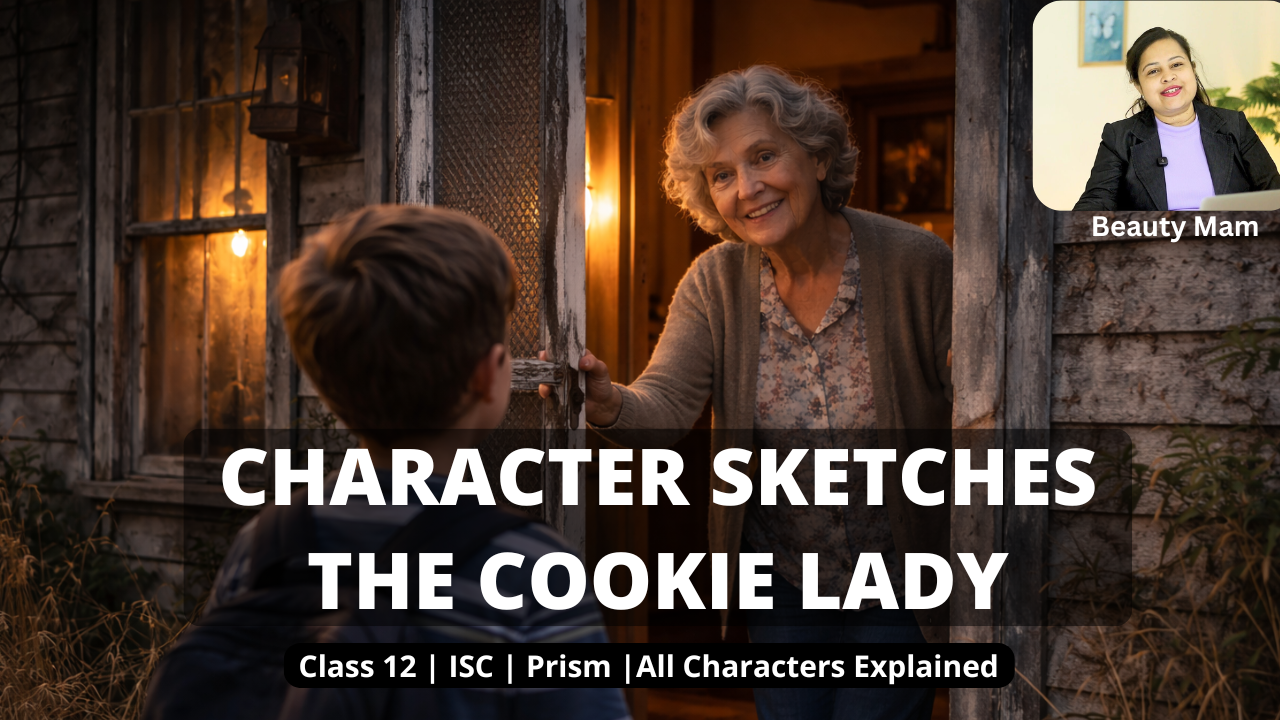
Mrs. Drew, also known as The Cookie Lady, is the most important and terrifying character in the story. At first, she appears to be a kind, lonely old woman who enjoys the company of a young boy. However, as the story progresses, her true nature is revealed.
1. Deceptive and Manipulative
Mrs. Drew presents herself as a sweet, grandmotherly figure. She bakes fresh cookies, offers milk, smiles warmly, and speaks gently to Bubber. She behaves like someone who simply wants company. However, this kindness is only a mask. She carefully attracts Bubber with cookies and uses his innocence for her own benefit. Her warmth is not genuine love — it is a strategy to keep him coming back.
2. Supernatural and Vampiric
Mrs. Drew possesses a strange, supernatural power. When Bubber reads to her and sits close to her, she begins to grow younger. Her wrinkles fade, her grey hair turns dark, and her weak body becomes strong. At the same time, Bubber becomes pale and exhausted. She does not drink blood like a traditional vampire, but she drains his youth and life force. Her power works silently and invisibly, making her even more frightening.
3. Selfish and Vicious
Mrs. Drew’s strongest desire is to feel young again. She is desperate to escape old age and weakness. This selfish desire makes her cruel. Even when she realizes that Bubber is growing weaker, she shows no guilt or concern. During the final visit, she knowingly drains him completely, choosing her own youth over his life. Her happiness at the end shows how little she values the boy’s existence.
4. Emotionally Isolated
Mrs. Drew lives alone in an old, broken house surrounded by dry weeds. This setting reflects her inner emptiness and separation from society. She has no real human connections. Instead of seeking companionship in a healthy way, she exploits a child. Her isolation symbolizes her moral decay and distance from normal human feelings.
5. A Symbol of Hidden Evil
Mrs. Drew represents the idea that evil does not always appear frightening. Sometimes it hides behind kindness, smiles, and simple pleasures like cookies. She teaches the reader that danger can exist where we least expect it.
In conclusion, Mrs. Drew is a complex character who appears harmless but is actually dangerous and selfish. Through her, the author shows how greed for youth and fear of aging can destroy innocence and life itself.
Character Sketch of Bernard “Bubber” Surle
Bernard “Bubber” Surle is the young boy at the centre of the story. He is only nine years old and represents innocence, vulnerability, and childhood simplicity. Through his character, the author highlights how easily innocence can be exploited.
1. Innocent and Naive
Bubber is a typical young child who loves sweets. He visits Mrs. Drew mainly because of her delicious cookies. He does not suspect that anything is wrong. Even when Mrs. Drew watches him closely or sits unusually near him, he remains unaware of the hidden danger. His innocence prevents him from seeing her true intentions.
2. Lonely and Vulnerable
Although Bubber has a friend named Ernie, he often spends his afternoons alone at Mrs. Drew’s house. This suggests that he lacks strong companionship and attention elsewhere. Mrs. Drew becomes someone who gives him food and mild attention, which makes him feel comfortable. His emotional vulnerability makes him an easy target for her manipulation.
3. Obedient and Oblivious
Bubber is obedient and polite. When Mrs. Drew asks him to read, he agrees. When his parents allow him one last visit, he follows their instructions. Even as his body becomes weaker and more exhausted after every visit, he does not understand what is happening. He continues going back, unaware that his youth and life are slowly being drained.
4. A Symbol of Childhood Innocence
Bubber represents the purity and simplicity of childhood. He trusts easily. He focuses only on immediate pleasure — cookies — without thinking about consequences. His tragic fate shows how innocence can be destroyed by selfish and evil forces.
5. Victim of Adult Inattention
Although his parents eventually grow suspicious, they fail to recognize the seriousness of the situation in time. His gradual weakness is noticed but not properly understood. This highlights a theme of parental or societal failure to fully protect children from hidden dangers.
In conclusion, Bubber is an innocent, trusting, and vulnerable child whose simplicity leads to his tragic end. Through his character, the story shows how greed and selfishness can destroy innocence.