

 by
by Overview of all Scenes | Questions that can be asked in Exam
What Happened Before Act 5
Context Before Act 5, Scene 1
Before Act 5, Scene 1, Macbeth has become a ruthless tyrant. He has ordered the murder of Banquo and Macduff’s family because he believes violence will secure his throne. While Macbeth grows more brutal and confident in the prophecies of the witches. Lady Macbeth’s role has changed. Earlier, she was the driving force, the mastermind behind Duncan’s murder, but now she is isolated, guilty, and mentally disturbed. The weight of their crimes has begun to affect her very deeply, even though she once appeared fearless and strong.
Act 5, Scene 1 — Detailed Summary
This scene takes place at night inside the castle. A doctor and a woman observe Lady Macbeth as she sleepwalks. She enters holding a candle, which shows her fear of darkness and guilt — now THIS is a sharp contrast to the confidence she had earlier. While sleepwalking, she begins to speak loudly and unknowingly revealing her inner thoughts.
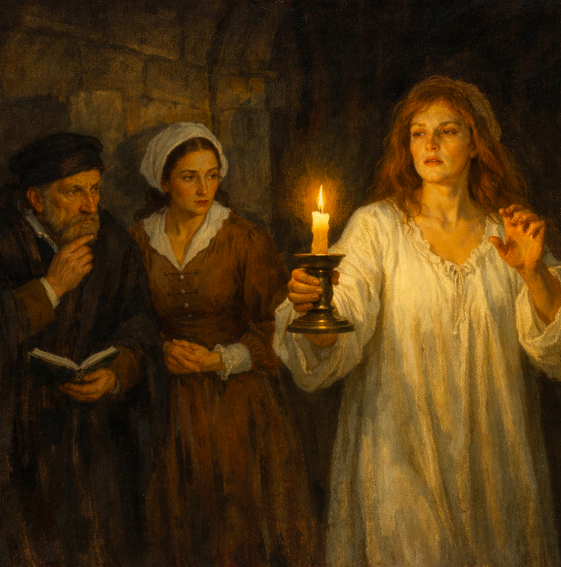
Lady Macbeth repeatedly rubs her hands, imagining that they are stained with blood. She cries, “Out, damned spot!” THIS shows her obsession with washing away guilt. She mentions Duncan’s murder, Banquo’s death, and the killing of Lady Macduff. It proves that all these crimes are haunting her mind. THESE secrets, which were once hidden very carefully, are now spilling out uncontrollably.
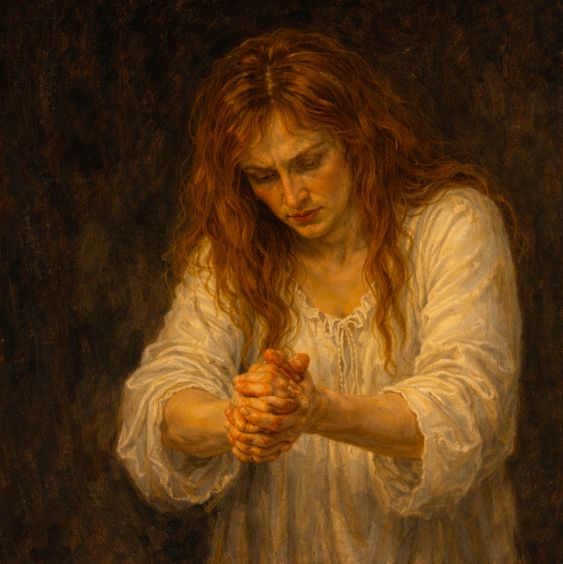
The doctor realizes that Lady Macbeth is suffering from a mental illness caused by guilt, not a physical disease. He says that medicine cannot cure her — only repentance or divine forgiveness can help. The woman is shocked to see all this, and she is afraid, knowing that Lady Macbeth has witnessed dangerous truths.
By the end of the scene, Lady Macbeth leaves, still trapped in her disturbed state. The doctor warns that she needs constant care and there are chances that she may harm herself.
This scene is crucial because it shows the complete reversal of Lady Macbeth’s character. The woman who once made fun of Macbeth’s fear is now broken by guilt. It highlights one of the central ideas of the play that guilt cannot be escaped. While Macbeth tries to silence his conscience through violence, Lady Macbeth is destroyed by the memory of their sins.
In Boards 2025, there was a 5 marks question asked-
What secrets does Lady Macbeth reveal as she walks in her sleep in Act V Scene i? What changes do you notice in her from the Banquet scene in Act III?
That was all about Act 5, scene 1. Now moving ahead to Act 5, Scene 2.
Act 5, Scene 2 — Detailed Summary
This short but important scene takes place near Birnam Wood. A group of Scottish lords — including Menteith, Caithness, Angus, and Lennox — is moving to join Malcolm’s army. Their conversation clearly shows that Macbeth has lost the loyalty of his people.
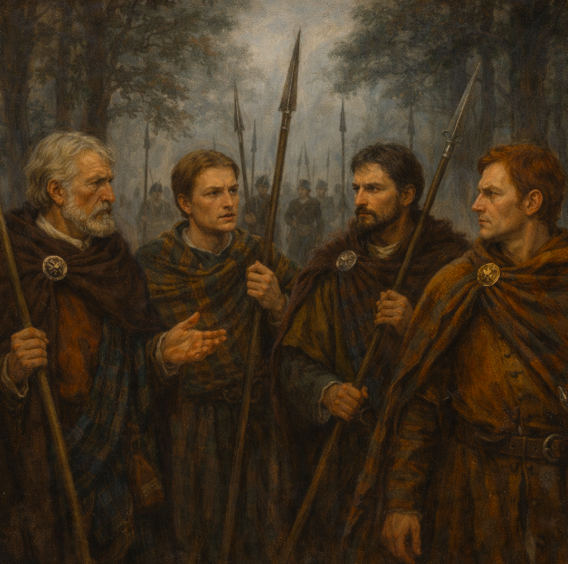
The lords openly criticize Macbeth, calling him a “tyrant” rather than a king. They say he is surrounded by soldiers who obey him out of fear, not loyalty. His crimes, especially the murder of Duncan and Macduff’s family, have isolated him completely. Although Macbeth is still wearing the crown, but he no longer has respect or trust.
The lords discuss Macbeth’s mental state. They say that he is unstable and suffering from guilt and paranoia, that is, mistrust and suspicion. They also mention that Lady Macbeth is not well, hinting at her mental breakdown shown in the previous scene. This reinforces, strengthens the idea that both Macbeth and his wife are now paying the psychological price for their crimes.
The scene ends with the lords deciding to march toward Birnam Wood to unite with Malcolm and the English forces. Their goal is clear: to overthrow Macbeth and free Scotland from tyranny.
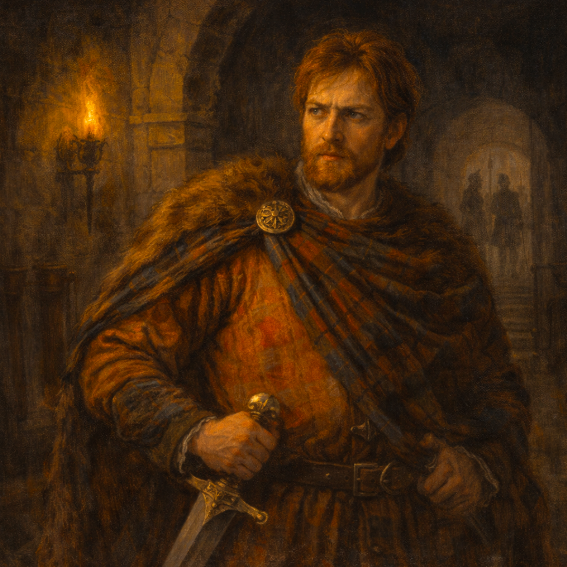
Though the scene is short, but it is important because it shows the political consequences of Macbeth’s actions. Shakespeare makes it clear that power gained through violence cannot last. Macbeth may still be king in name, but in reality, he stands alone — abandoned by his people and surrounded by enemies.
That was all about Act 5, scene 2. moving ahead to Act 5, Scene3.
Act 5, Scene 3 — Detailed Summary
This scene takes place inside Dunsinane Castle. Macbeth looks restless and disturbed, yet he shows himself to be confident. He gives orders to prepare for battle but speaks with arrogance. He claims that no enemy can defeat him because of the witches’ prophecies. He believes himself to be almost invincible.
When a servant reports that ten thousand soldiers are approaching, Macbeth reacts with anger rather than fear. He insults the servant and repeats that no man born of a woman can harm him. This shows how completely he depends on the witches’ words instead of reality.
A doctor enters and informs Macbeth that Lady Macbeth is seriously ill and mentally disturbed. Instead of showing concern or sympathy, Macbeth responds impatiently. He asks the doctor to cure her, but when he tells him that her illness is beyond medical help, he becomes frustrated. This reveals how far Macbeth has emotionally detached himself from his wife and from humanity itself.
In this context, there was 1 mark question asked in Board 2025, that-
In Act V Scene i of the play, Macbeth, the doctor says, “This disease is beyond my practice” because ____.
Explanation- Lady Macbeth’s illness is related to her mind and conscience. It is caused by guilt and mental disturbance, not by a physical disease that a doctor can cure.
Despite the growing threat, Macbeth orders his servants to bring him his armor, even though the battle has not yet begun. His behavior reflects inner panic, which is masked by forced confidence. He talks about life as empty and meaningless.
The scene ends with Macbeth preparing for war, clinging blindly to the witches’ prophecies. Shakespeare presents him as a tragic figure — bold on the outside but deeply insecure inside. This scene highlights Macbeth’s fatal flaw: his overconfidence in fate and prophecy, which prevents him from seeing the danger clearly and leads him toward his final downfall.
That was all about Act 5, scene 3. Moving on to the summary of Act 5, scene 4.
Act 5, Scene 4 — Detailed Summary
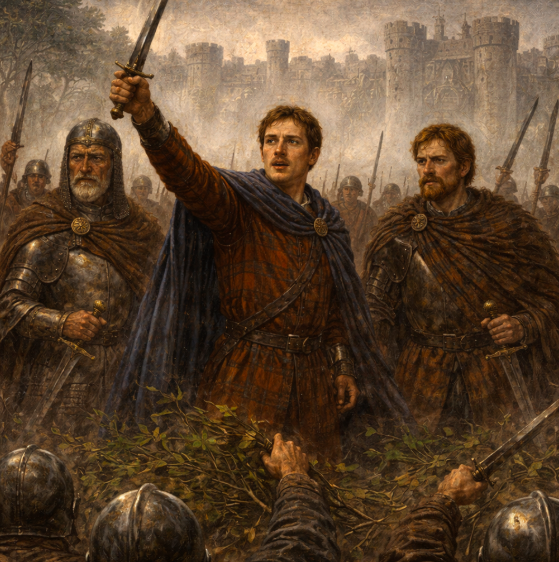
This scene takes place near Birnam Wood. Malcolm, Siward, and Macduff discuss their military strategy as they prepare to attack Macbeth’s castle. Malcolm gives a clever command to his soldiers: each man should cut down a branch from Birnam Wood and carry it in front of him as they march.
The purpose of this plan is to hide the true size of their army from Macbeth’s scouts- a soldier or other person sent out ahead of a main force so as to gather information about the enemy’s position, strength, or movements. By covering themselves with branches, the soldiers will appear fewer in number, giving them a strategic advantage.
This simple military tactic has a powerful and dramatic effect. Without realizing it, Malcolm’s army begins to fulfill the witches’ prophecy that Birnam Wood will move toward Dunsinane Hill. What once sounded impossible is now becoming reality — not through magic, but through human action and intelligence.
The scene is short but highly significant. It marks the moment when fate starts turning decisively against Macbeth.
That was all about Act 5, scene 4. Moving ahead to Act 5, Scene 5.
Act 5, Scene 5 — Detailed Summary
This scene takes place inside Dunsinane Castle. Macbeth hears a cry from within the castle and is told that Lady Macbeth is dead. His reaction is cold and weary rather than emotional. He reflects that she would have died sooner or later anyway. This moment shows how emotionally numb Macbeth has become after so much violence.
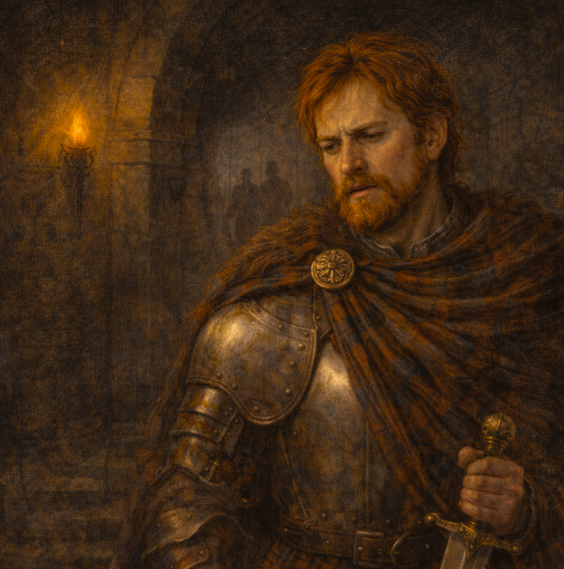
Macbeth then delivers his famous “Tomorrow, and tomorrow, and tomorrow” speech. In this speech, he describes life as meaningless, repetitive, and empty. He compares life to a shadow and a poor actor who performs on stage for a moment and then disappears. This reveals Macbeth’s deep despair and loss of purpose — ambition has brought him power, but no happiness.
Soon after, a messenger brings shocking news: Birnam Wood appears to be moving toward Dunsinane. At first, Macbeth is furious, and disbelief strikes him. Then fear begins to creep in as he realizes that the witches’ prophecy is coming true. For the first time, his confidence in the prophecies starts to crack.
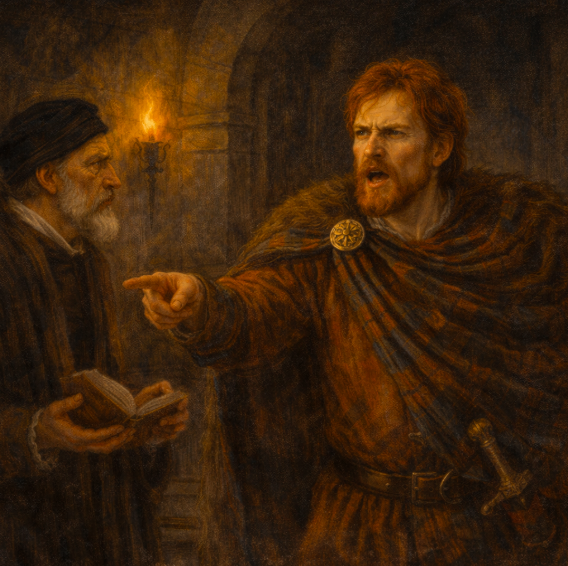
In this context, tehre was an MCQ asked in Boards 2025-
In Act V Scene v of the play, Macbeth, what is Macbeth’s first reaction when the messenger informs him that “the wood began to move”? (a) He disbelieves the messenger and calls him a “liar.” (b) He wants to see the sight for himself. (c) He sends a message to his General. (d) He loses all hopes.
So the correct answer is – Option: (a) He disbelieves the messenger and calls him a “liar.”
Despite this, Macbeth decides to fight to the end. Even though he senses his downfall is near, he refuses to surrender. He resolves to face his enemies in battle rather than die without resistance.
This scene is crucial because it marks Macbeth’s emotional collapse and the collapse of his faith in the witches. By the end of the scene, Macbeth is no longer driven by hope or ambition — only by desperation and confrontation.
That was all about Act 5, scene 5. Moving ahead to Act 5, Scene 6
Act 5, Scene 6 — Detailed Summary
This very short scene takes place outside Dunsinane Castle. Malcolm, Siward, and Macduff give final instructions to their soldiers before the battle begins. Malcolm orders the army to drop the branches they have been carrying and prepare for open fight.

The leaders encourage their men to fight bravely and confidently. The English and Scottish forces are united with a clear purpose: to defeat Macbeth and free Scotland from tyranny. Unlike Macbeth’s army, which is held together by fear, Malcolm’s forces are motivated by justice and loyalty.
Although short, this scene is important because it marks the official beginning of the final battle. It shows that the moment of action has arrived after all the planning and tension. The witches’ prophecy has now fully turned against Macbeth, and there is no escape left for him.
Act 5, Scene 6, serves as a transition scene, moving the play from psychological conflict to physical confrontation.
That was all about Act 5, scene 6. Moving ahead to Act 5, Scene 7.

Act 5, Scene 7 — Detailed Summary
This scene takes place on the battlefield. Macbeth appears fighting bravely and violently, killing young Siward in combat. When Siward’s son challenges him, Macbeth confidently kills him, believing once again that the prophecies protect him from death.
Macbeth boasts that he cannot be killed by any man born of a woman. Meanwhile, Macduff enters the battlefield, searching desperately for Macbeth. Unlike others, Macduff is driven not by ambition but by justice and revenge for the murder of his wife and children. He refuses to fight anyone else until he finds Macbeth.
Somewhere else in the battle, Malcolm and old Siward discuss the progress of the fight. They come to know that young Siward has died bravely in the fight. Siward reacts with controlled pride rather than grief, saying that his son died honorably, like a true soldier.
The scene ends with tension rising as Macbeth and Macduff move closer to their final confrontation.
This scene is important because it highlights Macbeth’s tragic courage and fatal flaw at the same time. He fights fearlessly, yet blindly trusts the witches.
That was all about Act 5, scene 7. moving ahead to act 5, scene 8.
Act 5, Scene 8 — Detailed Summary
This final scene of the play takes place on the battlefield. Macbeth and Macduff finally meet face to face. Macbeth boasts confidently, declaring that he cannot be killed by any man born of a woman. He warns Macduff to stay away, because he believes that the prophecy still protects him.
Macduff then reveals the crucial truth: he was not “born of a woman” in the natural way but was delivered by Caesarean section — he was “from his mother’s womb untimely ripped” . This revelation completely destroys Macbeth’s confidence. For the first time, he realizes that the witches deceived him by using misleading language.
Macbeth briefly thinks about surrendering and imagines the humiliation of being shown as a captured tyrant. However, his pride and courage as a warrior take over. He refuses to give up and decides to fight till the end rather than live with shame.
Macbeth and Macduff fight, and Macduff kills Macbeth in combat. With Macbeth’s death, the tyranny that haunted Scotland comes to an end.
Macduff returns carrying Macbeth’s severed head and presents it to Malcolm. Malcolm is hailed as the new King of Scotland. He announces that order and justice will be restored, and he invites everyone to his coronation at Scone. Malcolm also restores rightful titles to the nobles, symbolizing a return to peace and stability.
This scene completes Macbeth’s tragic journey. Shakespeare shows that ambition built on deception and violence leads to destruction. The witches’ prophecies do come true — but in ways Macbeth never understood. The play ends with justice restored, but only after immense suffering and loss.
Questions asked from the Telephone Conversation in Boards 2025 with answers
1. What secrets does Lady Macbeth reveal as she walks in her sleep in Act V, Scene i? What changes do you notice in her from the Banquet scene in Act III? [5 marks]
Ans- In Act V, Scene i, Lady Macbeth’s sleepwalking shows how deeply guilt has disturbed her mind and conscience. As she talks in her sleep, she unknowingly reveals her connection to the murders of Duncan, Banquo, and Lady Macduff. She keeps rubbing her hands as if scrubbing off blood, crying, “Out, damned spot!”, which shows she cannot escape her guilt.
This is completely different from Act III’s banquet scene, where she stays calm and cleverly distracts the guests from Macbeth’s strange behaviour, even scolding him for his “starting.” In the sleepwalking scene, her control is gone and her hidden fear, remorse, and guilt spill out. She is no longer the confident, ambitious woman directing everything, but a broken person haunted by what she helped set in motion.
2. In Act V Scene i of the play, Macbeth, the doctor says, “This disease is beyond my practice” because ____.
Ans- Lady Macbeth’s illness is related to her mind and conscience. It is caused by guilt and mental disturbance, not by a physical disease that a doctor can cure.
3. Do you think that Malcolm has the kingly qualities that Macbeth lacks?
Ans- Malcolm shows the qualities of a true king that Macbeth clearly lacks, which is why Malcolm is the better ruler. Macbeth is ruled by ambition and uses murder, lies, and fear to gain and keep power. Malcolm, in contrast, acts with honesty, wisdom, and real concern for Scotland.
In Act IV, Malcolm tests Macduff’s loyalty by pretending to have serious faults. This shows Malcolm is careful and intelligent—he understands how dangerous deception in politics can be, unlike Macbeth, who acts impulsively and trusts the wrong things. Malcolm also proves his love for Scotland when he speaks about the country’s suffering under Macbeth and expresses a sincere wish to bring back justice and stability. Macbeth’s goals, however, are mostly selfish.
Malcolm also shows strong leadership and planning. He builds support from England, gathers an army, and thinks strategically before taking action. He admits his weaknesses and listens to advice, showing humility, something Macbeth loses as he becomes more arrogant and isolated.
At the end of the play, Malcolm’s speech about restoring order, rewarding loyal supporters, and punishing the guilty shows his sense of responsibility and justice. This commitment to fair rule highlights the difference between a rightful king and Macbeth’s tyrannical reign.
4. The minor characters in the play act as commentators to the events that unfold in Scotland. Discuss the statement with reference to the Acts studied.
Ans- Minor characters in Macbeth often work like a chorus. Through their comments and reactions, they show how Scotland is falling apart and they strengthen the play’s main themes. Their words make Macbeth’s tyranny clearer.
For example, in Act III, Scene vi, Lennox and another Lord speak carefully but hint that they suspect Macbeth. They quietly question the reasons behind Banquo’s murder and Macduff’s sudden flight. The fact that they speak in a guarded way shows how dangerous it is to criticise the king and how fear and suspicion have spread across Scotland.
In Act IV, Scene ii, Lady Macduff’s conversation with her son highlights how innocent people suffer under Macbeth. The messenger’s warning to her shows the constant fear in the country and how Macbeth’s violence can strike anyone without reason. In Act V, Scene i, the doctor watching Lady Macbeth sleepwalk understands that “unnatural” crimes have damaged the royal household. His inability to treat her suggests that this is not just a medical problem, but a deeper moral and spiritual collapse.
Similarly, in Act IV, Scene iii, Ross describes to Macduff how Scotland is full of pain, disorder, and suffering. Together, these minor characters act as witnesses to the tragedy. They expand the story beyond Macbeth and Lady Macbeth, showing the wider consequences of ambition and evil, and the struggle between order and chaos.