
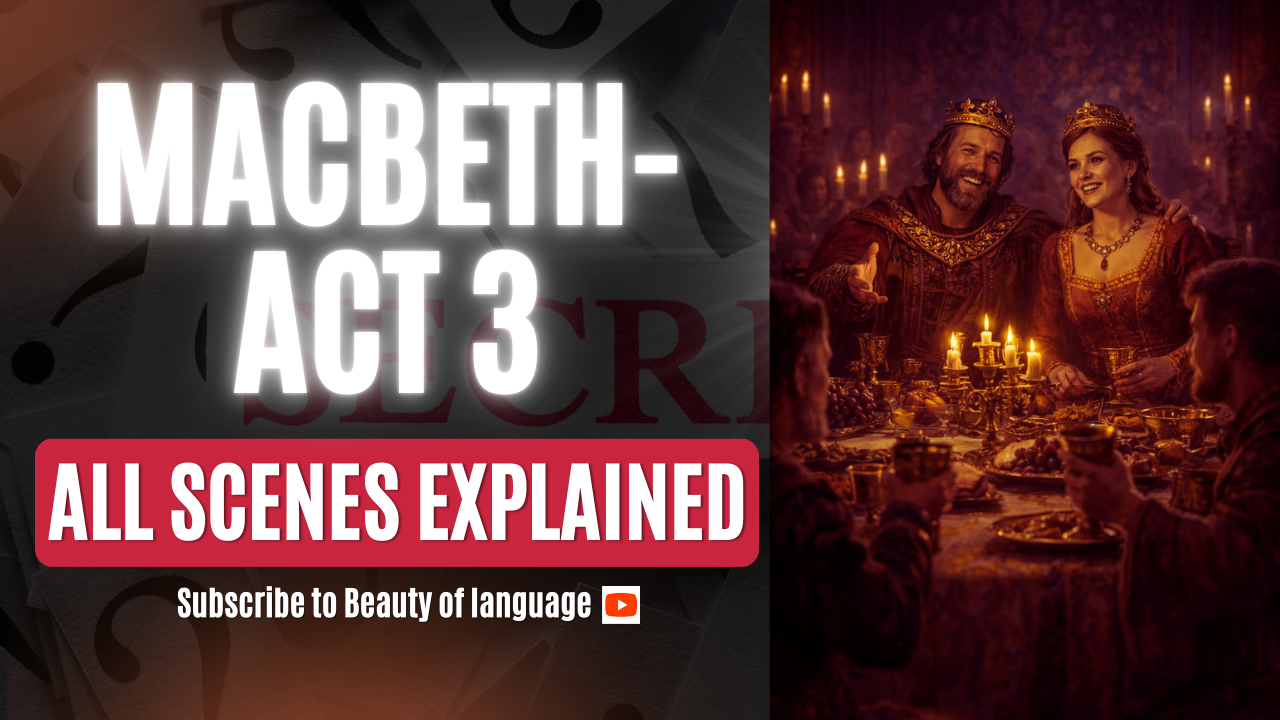
 by
by Overview of all Scenes | Questions that can be asked in Exam
What Happened Before Act 3, Scene 1
By the end of Act 2, we saw that:
- Macbeth is prompted by the prophecy of the witches and Lady Macbeth. As a result, he murders King Duncan to seize the throne of Scotland.
- Duncan’s sons, Malcolm and Donalbain, run from Scotland, fearing for their lives after their father’s murder, and because of this move, they are under suspicion.
- Macbeth is crowned king, but the guilt and moral consequences of his crime begin to weigh on him.
- Banquo remembers the witches also said his children will be kings, so he starts feeling something is wrong about Macbeth’s sudden rise.
Summary: Act 3, Scene 1
Setting is in Forres, the palace where Macbeth now lives.
- Banquo’s Thoughts
Banquo reflects privately on the witches’ prophecy that Macbeth would become king and that his (Banquo’s) own children would inherit power in the future. Because Macbeth is now king, he suspects something foul may have happened—but he tries not to think about those negative things. - Macbeth’s Invitation
Macbeth enters with Lady Macbeth and other nobles. He announces a feast for that evening and warmly invites Banquo as the honoured guest. Banquo says he will attend after riding out with his son Fleance during the afternoon. - Macbeth’s Soliloquy
When Macbeth is alone, he reveals his fear that the prophecy of the witches about Banquo’s heirs threatens his own position. He thinks that if Banquo’s children become kings, his own violent actions, that is, killing Duncan, would have been in vain. This soliloquy shows Macbeth’s growing suspicion and ambition.
In the context of this soliloquy, there was an MCQ asked in the exam, in the 2025 boards that-
In his soliloquy in Act III, Scene i of the play, Macbeth, which one of the following does Macbeth refer to as a reason for fearing Banquo?
(P) Banquo is close to Lady Macbeth.
(Q) Banquo is royal in nature.
(R) Banquo’s descendants will become kings.
(S) Banquo is a poor advisor.
(a) Only (P) and (Q) (b) Only (Q) and (R) (c) Only (R) and (S) (d) Only (P) and (S)
So what will be the correct answer- (b) Only (Q) and (R)
Explanation: In his soliloquy in Act 3, Scene 1, Macbeth reveals his fear of Banquo. Where is this fear coming from? It is arising from Banquo’s noble character and the witches’ prophecy that his sons will be kings. Macbeth now sees Banquo as a direct threat to his authority, and he is worried that Banquo’s lineage, that is, Banquo’s descendants, will ultimately overthrow him.
4. The Murder Plot
Macbeth summons two men and persuades them to murder Banquo and Fleance. He manipulates them by convincing them that Banquo is their enemy and that killing him would benefit them. Macbeth’s insecurity and willingness to order more murders mark a critical shift: he is now fully committed to tyranny to secure his throne.
So that was all that happened in Act 1, Scene 1. Now moving ahead, Act 3, Scene 2.
What Happened Before Act 3, Scene 2
In Act 3, Scene 1, Macbeth felt threatened by Banquo and the prophecy that Banquo’s children will be kings. His fear turned into insecurity, and he secretly planned Banquo and Fleance’s murder using hired killers. Lady Macbeth does not yet know about this new plan.
Act 3, Scene 2 – Summary
When you chase success at any cost, is it worth it if you never sleep peacefully again?
Macbeth and Lady Macbeth are starting to realise the price.
Lady Macbeth enters feeling anxious and uneasy. She explains that although she and Macbeth have achieved what they wanted and that Macbeth is now king, but neither of them is truly happy. Instead of peace, they now live with fear, guilt, and sleeplessness. She reflects that gaining power is useless if they cannot enjoy it.
She sends a servant to call Macbeth. While waiting, she speaks to herself and says that dangerous thoughts are troubling them both. When Macbeth arrives, she tries to comfort him and encourages him to forget the past and enjoy the present. However, Macbeth’s mind is still full of worry.
Macbeth tells her that although their positions seem secure from the outside, inside, he feels trapped. He uses the image of a “snake” still remaining, hinting that threats still exist — especially Banquo and Fleance. Macbeth feels that as long as they are alive, his throne is not safe.
Lady Macbeth asks him what he plans to do, but Macbeth avoids giving details. He tells her to act normal and innocent at the banquet later, so no one suspects them. He suggests that something will happen that night — something dark — but he keeps the plan secret. This is a significant change: earlier, she was the mastermind, now Macbeth starts taking decisions alone.
You can be asked 10 marks question- Trace the development of Macbeth’s character in Act 3.
How does he change from a hesitant criminal to a confident tyrant? If you want a detailed answer for it, then let me know in the comments below.
Lady Macbeth senses something violent is coming, but Macbeth assures her she will soon be proud of what he will do. The scene ends with Macbeth determined to secure his kingship through more bloodshed, showing how power has made him ruthless and suspicious.
In the context of Lady Macbeth, there was another MCQ asked in the Baords 2025 that-
“Nought’s had, all’s spent, Where our desire is got without content;” What does this quote by Lady Macbeth in Act III, Scene ii of the play, Macbeth, reveal about her mental state?
(a) She feels Duncan’s murder was worth the effort.
(b) She is greedy for power.
(c) She is afraid of spending money.
(d) She realises the futility of power
So what will be the correct answer- (d) She realises the futility of power.
Explanation: Lady Macbeth’s speech in Act 3, Scene 2, shows that she is beginning to regret the pursuit of power. Even after becoming queen, she feels no peace or satisfaction. The word “content” highlights the absence of both happiness and fulfilment. This shows that their ambition has left them empty rather than rewarded.
That was all about Act 3, scene 2. Now moving ahead to Act 3, scene 3.
What Happened Before Act 3, Scene 3
In Act 3, Scenes 1 and 2, Macbeth feared Banquo and Fleance because the witches said Banquo’s children would become kings. To protect his crown, Macbeth secretly hires two murderers and later sends a third one as extra support. Lady Macbeth does not know this plan. Macbeth believes that only Banquo and Fleance’s deaths can secure his rule.
Act 3, Scene 3 – Summary
When you try to solve a problem with more problems…
Sometimes the mess only gets bigger. Macbeth learns this tonight.
Night has fallen. Two murderers wait on the road where Banquo and Fleance will pass on their way back to the palace. Soon, a third murderer, sent by Macbeth, arrives. He claims Macbeth ordered him to join them. This creates a sense of mistrust even among the killers — showing Macbeth no longer trusts anyone fully, not even those working for him.
As they discuss, Banquo and his son Fleance appear carrying torches. The murderers attack Banquo suddenly. Banquo fights back but is overpowered. It is 3 against 1 after all. Before dying, he cries out to his son, telling Fleance to escape and avenge him someday. Fleance manages to run away in the darkness, and the murderers lose track of him.
The murderers kill Banquo but fail to kill Fleance. They realize this is a big problem because Fleance is the real threat to Macbeth’s throne. They decide to report what has happened to Macbeth.
The scene is short but extremely important — it marks the turning point where Macbeth tries to control fate by violence, but fate slips from his hands. Banquo dies, but the prophecy lives on through Fleance’s escape.
That was all about Act 3, scene 3. Now moving ahead to Act 3, scene 4.
What Happened Before Act 3, Scene 4
In the previous scene, Macbeth’s plan to kill Banquo and Fleance is only half successful. Banquo is murdered, but Fleance escapes. And THIS means that the prophecy made by the witches that Banquo’s line will be kings still remains a threat. Now Macbeth is already uneasy, and this escape shakes him further.
Act 3, Scene 4 — Summary
Have you ever done something you regret so deeply that it haunts you even when nobody knows?
That’s Macbeth at this banquet.
The scene begins with a royal banquet. Macbeth and Lady Macbeth act warm and welcoming to the guests, trying to appear like a stable and confident king and queen. But Macbeth secretly looks tense inside. Why is he tense at THIS moment? Because he is waiting for news about the murder.
The first murderer arrives at the palace door. Macbeth steps aside and gets to know that Banquo has been killed, but Fleance escaped. The moment Macbeth hears this, his happiness disappears. He realises his position is still unsafe, and his sense of control shatters again.
Macbeth returns to the banquet table, trying to hide his shock. When he sits down, he sees something horrifying — the ghost of Banquo sitting in Macbeth’s seat. No one else can see the ghost. Macbeth panics and starts speaking to the empty chair, and behaves strangely in front of the guests. They all become confused and worried because they don’t know what Macbeth is seeing.
In this context you can be asked 10 marks question that- Discuss the significance of Banquo’s ghost in Act 3, Scene 4.
What does it reveal about Macbeth’s mental state?
Lady Macbeth tries to save the situation, just like a good wife. She tells the guests that Macbeth often has strange fits and that they should ignore it. She then scolds Macbeth privately, telling him to calm down and not reveal guilt. But the ghost appears again, more frightening, and this time Macbeth loses control, shouting at it.
The banquet turns chaotic. Lady Macbeth realizes that they are losing respect, and suspicion may rise, so she quickly ends the gathering and asks the guests to leave at once.
After the guests exit, Macbeth and Lady Macbeth talk. Macbeth fears that blood will lead to more blood, which means more violence will follow. He feels trapped in a cycle of murder. He also decides to visit the witches again to learn more about his future. Lady Macbeth is exhausted, but Macbeth is determined to go further down this dark path.
You can also be asked- How does Shakespeare use the banquet scene to expose Macbeth’s guilt and insecurity?
That was all about Act 3, scene 4. Now moving ahead to Act 3, scene 5.
What happened Before Act 3, Scene 5
At the banquet, Macbeth saw Banquo’s ghost and behaved wildly in front of the nobles. The guests left confused and suspicious. Macbeth now feels insecure and decides to meet the witches again to know more about his future. This shows that his dependence on supernatural forces is increasing.
Act 3, Scene 5 — Summary
Seeking answers from dark forces may solve problems…
or create bigger ones.
In this scene, Macbeth doesn’t even know he’s the target.
The scene shifts away from Macbeth and focuses on the supernatural world.
The Three Witches meet Hecate, the goddess of witchcraft, and their leader. She is angry with them because they dealt with Macbeth without telling her or involving her in their plans. She scolds them for acting on their own.
Hecate says Macbeth is selfish, full of ambition, and only seeks the witches for his own gain. She believes he does not deserve help, but she still plans to control and confuse him. Her goal is to make Macbeth overconfident, so he will fall into his own trap. She suggests using visions and illusions to mislead him.
Hecate prepares a plan: when Macbeth returns to meet the witches (which he soon will), they will show him false prophecies that sound reassuring but are actually dangerous. She says they will draw him to destruction by filling him with false hope.
Before leaving, Hecate performs a short magical chant. The witches plan to meet Macbeth again in the morning, where he will demand answers and see new visions.
In this conext, there was 1 mark question asked in Boards 2025 that- In Act III Scene v of the play, Macbeth, Hecate is angry with the three witches because _______________.
So what is the reason- The reason is that they influenced Macbeth’s destiny without her approval, undermining her authority and disrupting the course of her intended plans.
You can be asked 10 marks question that- Explain how the witches and Hecate manipulate Macbeth in Act 3.
Why is false confidence more dangerous than fear?
That was all about Act 3, scene 5. Now moving ahead to Act 3, scene 6.
What Happened Before Act 3, Scene 6
In the previous scene, the witches planned to deceive Macbeth further with false prophecies. Meanwhile, Macbeth’s behaviour at the banquet has raised suspicion among the nobles, though no one dares to speak openly. Act 3, Scene 6 shifts away from Macbeth and shows how the people of Scotland are feeling under his rule.
Act 3, Scene 6- Summary
Macbeth rules Scotland.
But Scotland wants someone else.
Two lords talk privately about recent events. From their cautious conversation, we understand that many nobles now suspect Macbeth of murdering King Duncan and also Banquo. They know Fleance escaped, and that makes Macbeth uneasy. They also mention Macduff, who has refused to follow Macbeth’s commands and has gone to England. This is important because Macduff has gone to meet Malcolm, Duncan’s son, who is staying there. They hope to gather support together from the English king and return to Scotland to defeat Macbeth.
The lords speak sorrowfully about how Scotland is suffering under Macbeth’s harsh and fearful rule. People live in misery, and they crave for peace and justice to return. They hope that Malcolm and Macduff will succeed in bringing help and restoring the rightful order. The scene ends with a hint that rebellion is growing, and Macbeth’s power may soon be challenged.
That was all about Act 3, scene 6.
In the context of the whole Act 3, you can be asked long-answer question that- Show how Act 3 prepares the ground for Macbeth’s downfall.
Exam question Suggestion
Short Answer Questions
- Why does Macbeth fear Banquo in Act 3, Scene 1?
- What promise does Macbeth make to Banquo before planning his murder?
- How does Macbeth manipulate the murderers against Banquo?
- Why is Fleance’s escape important to the play?
- What does Lady Macbeth mean when she says they are not “content” in Act 3, Scene 2?
- Why does Macbeth keep his plan about Banquo secret from Lady Macbeth?
- What role does darkness play in Act 3?
- Why do the nobles grow suspicious of Macbeth during the banquet scene?
- Who is Hecate, and why is she angry with the witches?
- Why does Macduff refuse to attend Macbeth’s banquet?
Character-Based Questions
- How is Banquo presented as a contrast to Macbeth in Act 3?
- How does Lady Macbeth’s role begin to diminish in Act 3?
- Why can Macbeth no longer enjoy kingship in Act 3?
- How do the Scottish nobles view Macbeth by the end of Act 3?
Theme-Based Questions
- How is ambition shown to be destructive in Act 3?
- Examine the theme of guilt and conscience with reference to Banquo’s ghost.
- How does Shakespeare present the idea of appearance vs reality in Act 3?
- Discuss the role of fate vs free will in Macbeth’s decisions in Act 3.
One-Line / Objective Questions
- Who escapes Banquo’s murder?
- Who sends the third murderer?
- Who can see Banquo’s ghost?
- Where does Act 3, Scene 1 take place?
- Who goes to England in Act 3, Scene 6?