 by
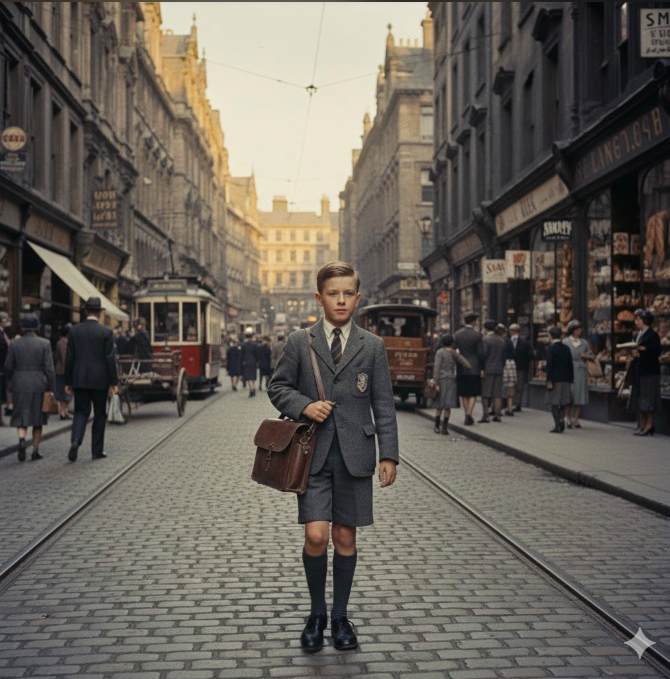
by Franz, a French schoolboy, tells this story. So he starts telling the readers that he was very late that morning, and was afraid that he was going to get a tight scolding. And from whom? From M. Hamel, his teacher, who was going to ask questions on particles. And Franz did not know even a word about it.
For a quick summary of the story, visit my channel Beauty Of Language.
He even thought about skipping the class that day and spending the whole day outdoors. After all, it was so beautiful outside. It must have definitely happened with you that when you don’t want to study, then everything else other than the class and the books looks and feels interesting. In the same way, Franz too felt that day. Birds chirping, open field, back of the sawmill, the Prussian soldiers were drilling. He found it all more tempting than the boring rules of participles. But still he went to school, resisting all of them.
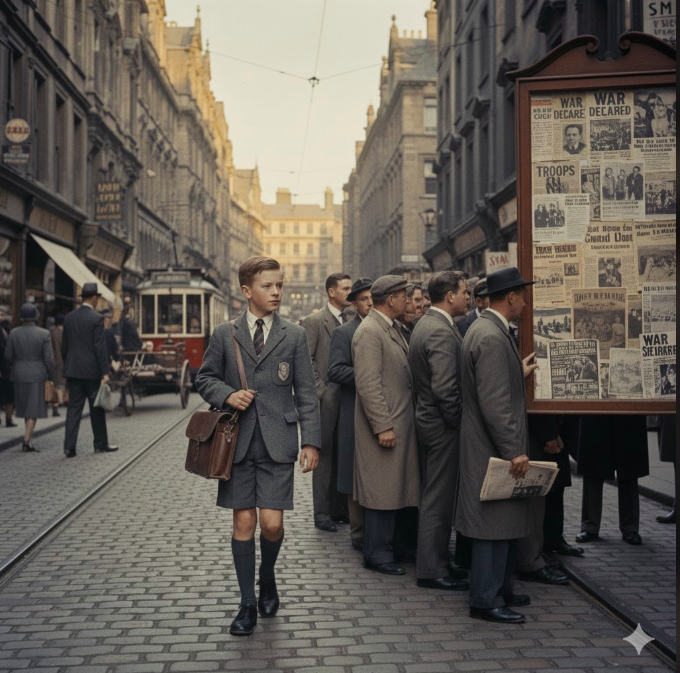
While he was passing through the town hall, there was a crowd in front of the bulletin board. He says that for the last two years, all the bad news has been coming from that. Like, the lost battles, the draft, the orders of the commanding officer. While passing, he thought, What can be the matter now?
On the way, he even met a blacksmith, Watcher, who told him not hurry, after all, he has a lot of time. He might be saying this sarcastically.
Normally, when school started, it was very noisy and busy. The noise was audible even from the street—desks opening and closing, students repeating lessons loudly together, and the teacher hitting the table with his big ruler to make everyone quiet.
But that day, everything was strangely silent. Franz was hoping that the usual noise would help him slip quietly into his seat without being seen. But his bad luck, the classrooom was a squiet as sunday morning.
From the window, he saw his classmates already sitting in their places, and M. Hamel walking up and down with his scary iron ruler. Franz had no choice but to open the door and walk in while everyone was watching. He felt extremely embarrassed, his face turned red, and he was very scared.
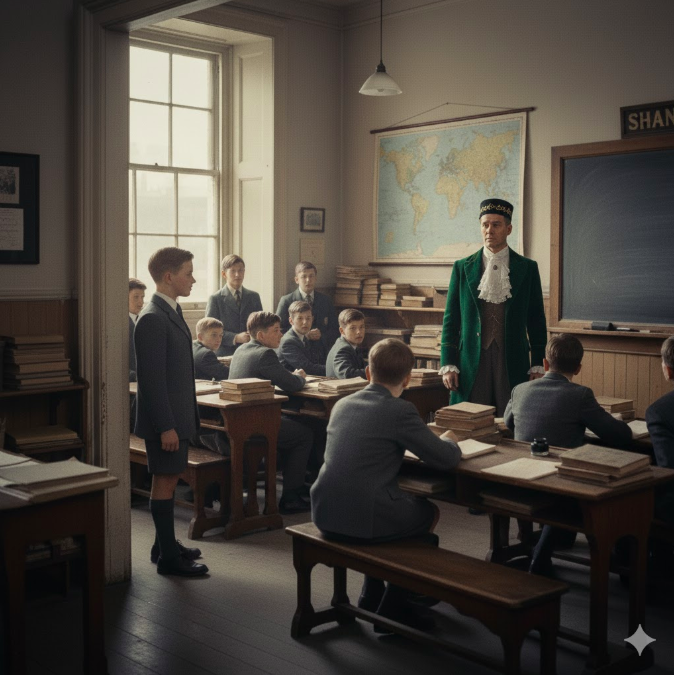
But to his surprise, nothing happened. M Hamel saw him and asked him to sit on hi place, and that they were going to start the lesson without him. He said all of it very kindly.
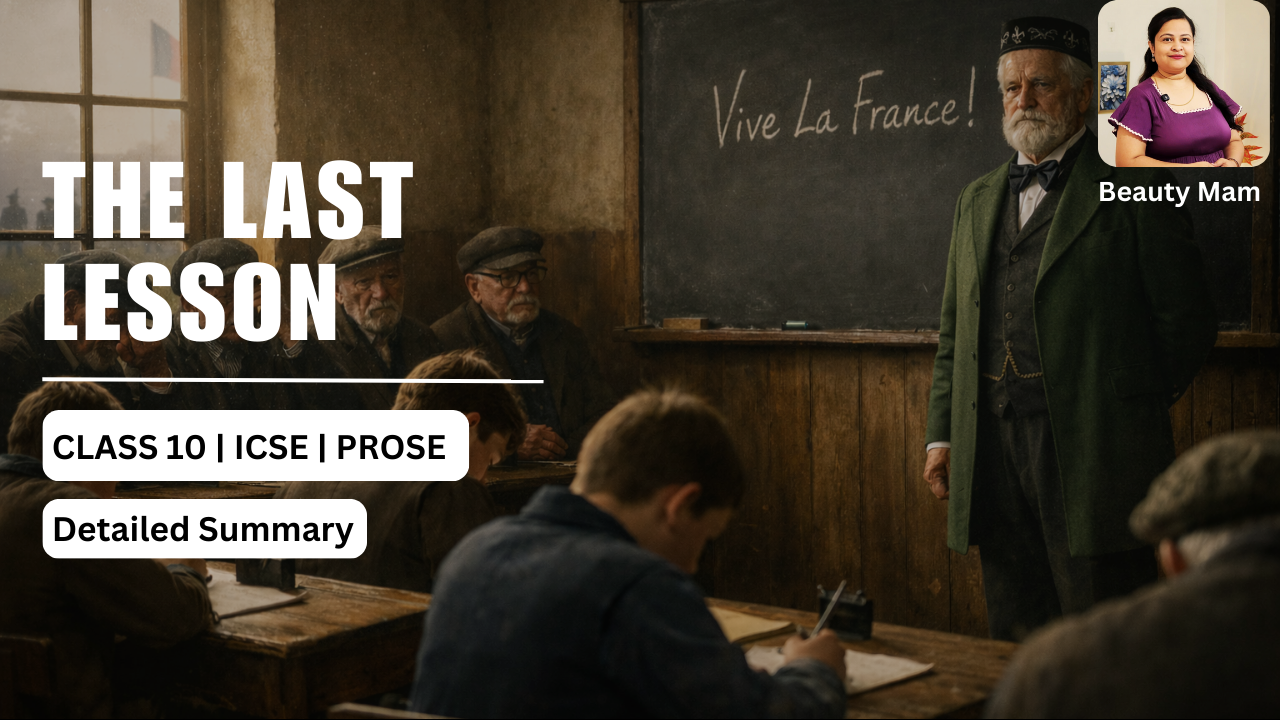
When he settled down, then he noticed that the teacher was wearing a beautiful green coat, his frilled shirt and the little black silk cap, all were embroidered. And M. Hamel wore all these very occasionally, only on special occasions. So he says that other than the whole class being strange, he noticed one more thing. At the back benches, which always used to be empty, the village people were sitting, and that also very quietly just like the rest of the students.
Then he describes who all were there. Old Hauser with his three-cornered hat, former mayor, former postmaster, and several others. Hauser even brought a book along with him that he kept opened on his knees. So while he was trying to figure out everything.
M. Hamel stood up on the chair and said in a very serious tone. The same grave and gentle tone that he used when he talked to Franz. He said- “My children, this is the last lesson I shall give you. The order has come from Berlin to teach only German in the schools of Alsace and Lorraine. The new master comes tomorrow. This is your last French lesson. I want you to be very attentive.”
These words were like a thunderclap for Franza. He was SHOCKED to hear that. Now he knew what had come up on the bulletin board at the town hall.
There was a sudden realization to him that- MY LAST FRENCH LESSON!! He thought, “I can’t even write properly. Now I will never get a chance to learn French again.” He felt deeply sorry for wasting time earlier. Instead of studying, he used to look for birds’ eggs or enjoyed sliding on the Saar river.
The books which he didn’t like at all now felt like old friends. His grammar book and history book, which once seemed heavy and annoying, suddenly became precious because he was about to lose them. We humans, have this tendency to take things for granted that are easily available to us. The moment we feel that it will be no more with us, we start to realize how important it is.
So he also started feeling emotional about M. Hamel. The mere thought that the teacher was leaving and he would never see him again, It made him forget how strict and angry M. Hamel used to seem. He forgot all about his ruler.
Franz felt sorry for M. Hamel. He understood why he had worn his best clothes. M. Hamel just wanted to make his last lesson special. It was to honour his last lesson. He also realised why the old men from the village were sitting at the back of the classroom. They were sad too, because they regretted not studying properly when they were young.
By coming to the class, they wanted to thank M. Hamel for his 40 years of honest service. They also wanted to show respect for their homeland, which was no longer truly theirs. It was THEIR way of thanking him.
While he was thinking all this, he heard his name. It was his turn to recite the grammar rule about participles. He wished he could say it confidently, loudly, and without any mistake. But as soon as he started, he got confused on the first few words. He just stood there holding his desk, his heart beating fast, and he was too scared to look up.
Then M. Hamel spoke kindly. He told Franz that he would not scold him because Franz already felt ashamed. M. Hamel explained that they always kept delaying learning, saying, “I have time, I’ll do it tomorrow.” And now they were seeing the result of that habit. He said this was a big problem in Alsace—people kept postponing learning. Now the new rulers could make fun of them by saying, “You call yourselves French, but you can’t even speak or write your own language.” M. Hamel also told Franz that HE was not the only one at fault. Everyone had something to blame themselves for.
M. Hamel told the class that their parents were also responsible. He said the parents did not care enough about their children’s education. Instead of sending them to school regularly, they preferred to send them to work on farms or in mills to earn a little extra money.
He then admitted that he himself was also at fault. Many times, he had asked the students to water his flowers instead of studying. Sometimes, when he wanted to go fishing, he even gave the class a holiday.
After that, M. Hamel started talking about the French language. He said French is one of the most beautiful languages—clear and logical. He told them to protect it and never forget it. He explained that when people are ruled by others, their language is like a key that helps them stay strong and hope for freedom.
Then he opened the grammar book and taught the lesson. Franz was surprised at how well he understood it that day. Everything felt simple. He listened more carefully than he had ever listened before, and M. Hamel also explained with great patience. It looked like the teacher wanted to give them all his knowledge before leaving, in that one last shot, as if he was trying to teach everything in that one final lesson.
After the grammar lesson, the class had a writing lesson. M. Hamel had brought new writing sheets for the students. On the sheets, it was written, in a very neat and beautiful handwriting: “France, Alsace, France, Alsace.” Again and again. These sheets were hung above their desks and looked like small flags all around the classroom.
Everyone started writing seriously, and the room became very quiet. The only sound was the pens scratching on paper. Even when some beetles flew into the room, nobody paid attention—not even the smallest children. They kept working, tracing their shapes carefully as if that was also a part of learning French.
Outside, pigeons were softly cooing on the roof. Franz wondered if the new rulers would try to force even the pigeons to “speak” German.
Whenever Franz looked up, he saw M. Hamel sitting still and silently looking around the room. It seemed like he wanted to remember every detail of the classroom forever.
For forty years, M. Hamel had taught in the same place, with his garden outside the window and his students sitting in front of him. Over time, the desks had become smooth from use, the walnut trees in the garden had grown taller, and the hopvine he had planted had climbed up to the roof. Franz felt it must be heartbreaking for M. Hamel to leave everything. He could even hear M. Hamel’s sister upstairs, packing their trunks, because they had to leave the country the next day.
But Franz stayed strong and listened to every lesson until the very end. After the writing work, the class had a history lesson. Then the little children began repeating their basic sounds: “ba, be, bi, bo, bu.”
At the back of the room, an old man named Hauser wore his spectacles and held his primer, the primary book for children, with both hands. He slowly spelt the letters along with the children. He was crying too. His voice was shaking with emotion. It felt both strange and touching, and the students felt like laughing and crying at the same time. THAT last lesson stayed deeply in everyone’s memory.
Suddenly, the church clock struck twelve, and the Angelus bell rang. At the same time, the sound of Prussian trumpets came from outside, as the soldiers returned from their drill.
M. Hamel stood up, looking very pale, but he also looked taller and stronger than ever. He tried to speak and say, “My friends, I…” but his voice broke, and he could not continue.
Then he turned to the blackboard, picked up a piece of chalk, and with all his strength wrote in big letters:
“Vive La France!” (Long live France!)
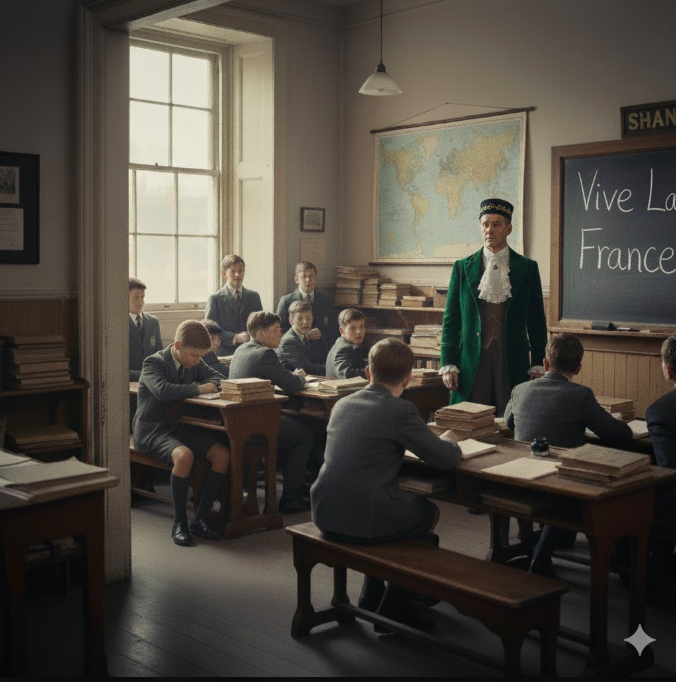
After writing it, he leaned his head against the wall. Without saying anything, he made a hand gesture to the class, meaning:
“School is dismissed. You may go.”
In “The Last Lesson,” the story shows that a person’s mother tongue is closely connected to their identity and freedom, and losing it feels like losing a part of themselves. The story also highlights how war can force people to give up their language and education, teaching that learning should not be delayed until it is too late.
Question Suggestions for Boards Class 10
1) Extract-based questions
- Who is speaking / narrating in this extract?
- Where is the scene taking place?
- What is happening at this moment in the story?
- Why is the atmosphere different from normal days?
- What do specific words/phrases in the extract mean (e.g., bustle, commotion, Angelus, choked)?
- What emotion is shown here? Give proof from the lines.
- What does this moment reveal about M. Hamel / Franz / villagers?
2) Very short answer questions
- Who is the narrator?
- Which districts were taken over?
- What order came from Berlin?
- How long had M. Hamel taught in the school?
- Why were the village elders sitting in the class?
- What did M. Hamel write on the blackboard at the end?
- What is the Angelus?
- What was Franz afraid of at the beginning?
3) Short answer questions
- Why was the classroom unusually silent that day?
- Why did Franz feel guilty during the last lesson?
- What made Franz suddenly become serious about learning French?
- Why did M. Hamel wear his best clothes that day?
- Why did Hauser and the villagers attend the class?
- What reasons does M. Hamel give for people not learning French properly?
- How does the story show the sadness of losing one’s language?
- Why does Franz start respecting M. Hamel by the end?
4) Long answer questions
- Explain how the story highlights the importance of mother tongue.
- Describe M. Hamel’s last day at school and the mood in the class.
- “We realize the value of something only when we lose it.” Explain using the story.
- How does the Prussian order affect the people emotionally and culturally?
- Discuss the theme of regret and procrastination in the story.
- Describe Franz’s transformation from the start to the end of the story.
5) Character sketch questions
- Franz as a narrator: his nature, fears, change in attitude.
- M. Hamel: strict teacher, patriot, emotional, responsible, sincere.
- Village elders (Hauser, etc.): what they represent and why they come.
- Compare Franz and the villagers in terms of regret and realization.
6) Theme-based questions
- Language and identity
- Patriotism and cultural pride
- Loss, regret, and guilt
- Education and responsibility
- War and forced cultural change (assimilation)
- Freedom and self-respect through language
- “How is language shown as a ‘key’ to freedom?”
- “How does the story connect language with culture and self-respect?”
7) Title-based questions
- Why is the title “The Last Lesson” suitable?
- What is “last” in the story—only a class, or something bigger (culture/identity)?
- Suggest an alternative title and justify it.
8) Message / moral / value-based questions
- What lesson does the story teach students today?
- What values does M. Hamel represent?
- What is the message about delaying learning?
10) “Why” and “How” reasoning questions
- Why does Franz understand the lesson better on the last day?
- How does fear change Franz’s mindset?
- Why does M. Hamel blame himself too?
- How does the author create emotional impact in the ending?
11) Compare/contrast questions
- Compare Franz’s feelings at the start vs the end.
- Compare a normal school day vs the last day.
- Compare M. Hamel’s strictness earlier vs kindness in the last lesson.
12) Quote/line explanation questions
Explain the meaning and importance of lines like:
- “As long as people hold fast to their language, it is as if they had the key to their prison.”
- “Will they make the pigeons sing in German?”
- “Vive La France!”
13) Creative writing-based questions
- Diary entry by Franz after the last lesson.
- Letter by Franz to a friend describing the day.
- Speech on “Importance of Mother Tongue.”
- Paragraph: “What I learned from M. Hamel.”